Tree Safety
Tree Risk Warning Signs Georgia Homeowners Should Not Ignore
Georgia homeowners can spot hanging limbs, trunk defects, leaning, decay, and storm damage before a tree threatens people or property.
Read article →The popular image of tree roots — a deep, anchor-like taproot driving straight down into the earth — is mostly fiction for mature trees. Most established hardwoods and conifers have root systems that are concentrated in the top 12 to 18 inches of soil, spreading outward in a broad, shallow plate.
This isn't an accident. The top layer of soil is where oxygen, water, and nutrients are most available. Roots grow where conditions support growth. In compacted, poorly drained, or clay-heavy soils — common in Cobb County — the active root zone is often shallower, sometimes confined to the top 6 to 12 inches.
A juvenile tree will develop a taproot in its first few years, which provides initial stability. As the tree matures, that taproot becomes less significant relative to the lateral root system, which expands outward continuously. By the time a tree is 10 to 15 years old, its structural support and most of its water and nutrient uptake are coming from lateral roots, not a taproot.
ISA research documents that a mature tree's root system typically extends 2 to 3 times the radius of the crown — and in many species, significantly farther. A large oak with a 40-foot crown radius can have roots extending 80 to 120 feet from the trunk in all directions.
That means the root system of a single mature tree often extends well beyond the property where the tree is planted, reaching into neighboring yards, under driveways, under sidewalks, and potentially under foundations — all without any visible above-ground indication.
Feeder roots — the fine, hair-like roots responsible for most water and nutrient uptake — are concentrated near the outer edge of the root system, in what's called the critical root zone. This is also where roots are most vulnerable to damage from soil disturbance, compaction, or grade changes.
Some tree species produce more problematic root systems than others — particularly in terms of surface root growth and structural root spread near hardscape.
Willow species (including weeping willow and black willow) are among the most aggressive root-system trees in Georgia. They actively seek moisture, sending roots remarkable distances toward water sources — including irrigation pipes, septic lines, and storm drains. They're also fast-growing, which means the root system expands rapidly.
Silver maple (Acer saccharinum) produces a dense, shallow, and wide-spreading root system that is notorious for lifting sidewalks, cracking driveways, and invading drainage infrastructure. It's a fast-growing tree, which makes it popular for quick shade — and makes its root problems appear quickly as well.
Sweet gum (Liquidambar styraciflua) is extremely common in Cobb County and across the Southeast. Its roots are aggressive and tend to produce surface roots that can buckle sidewalks and patios. Combined with the species' tendency toward surface root growth in compacted soils, it's among the most common causes of hardscape damage in suburban Georgia.
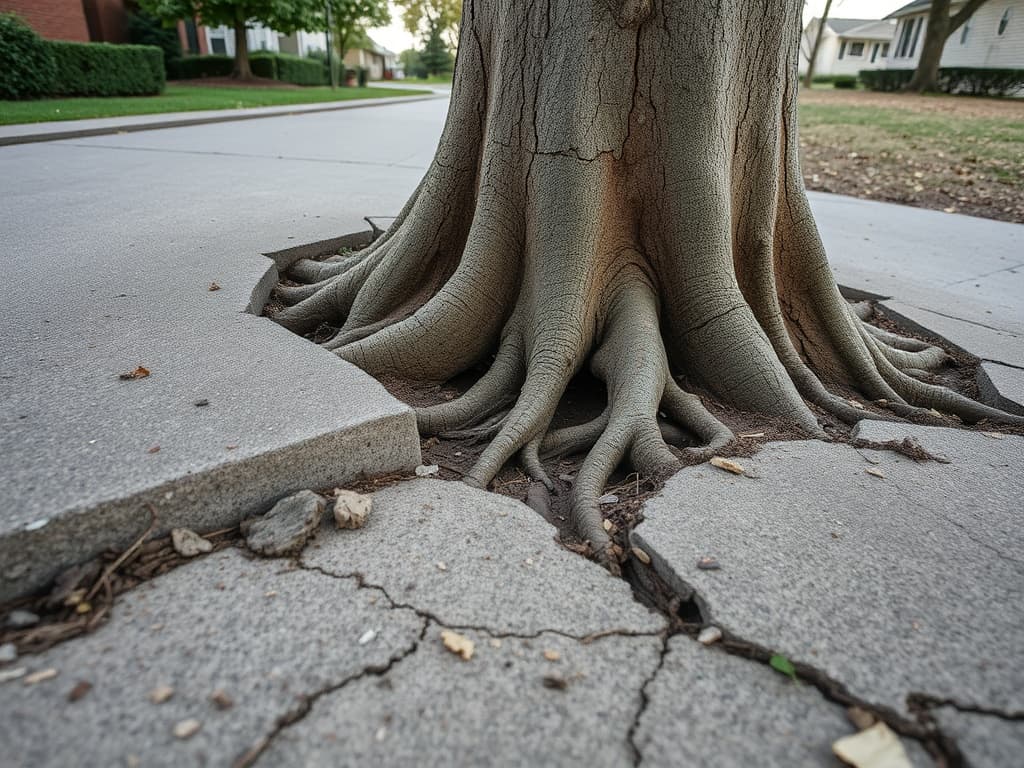
Sidewalk heaving is the most visible early sign of root encroachment under hardscape.
Generated by Polsia / Affordable Tree Experts
Root intrusion doesn't always announce itself with visible roots in obvious locations. The early signs are often in the hardscape and structure rather than in the tree.
Sidewalk heaving — sections of concrete lifted unevenly from below — is the most visible sign of root encroachment under hardscape. The same applies to driveway sections that have risen or cracked in a pattern radiating outward from a nearby tree.
Basement wall movement is a more serious concern. Roots typically don't physically break through intact foundation walls — they exploit existing cracks and gaps, growing through them and expanding as they mature, widening any existing defect. If you have an older foundation with existing crack patterns and a large mature tree within 20 feet, a structural engineer assessment is worth considering.
Clay soil complicates this further. Large tree roots in clay extract significant soil moisture, causing shrink-swell cycles in the clay layer that can produce differential foundation settlement — cracking and shifting unrelated to direct root contact. In drought years, this effect is amplified.
Root damage from construction activity is one of the most common — and most misunderstood — causes of tree decline in residential settings. It's also one of the most frustrating, because the symptoms often don't appear until long after the work is done.
ISA research documents a well-established pattern: when trenching, grading, soil compaction, or fill placement occurs within a tree's critical root zone, the damage to feeder roots and structural roots is immediate. But the tree's visible response — crown dieback, leaf scorch, reduced vigor — typically doesn't appear until 3 to 7 years later, when the tree has exhausted its stored reserves compensating for the root loss.
This creates a diagnostic problem: by the time a homeowner notices the tree is in trouble, the construction project is long finished, the contractor is gone, and the connection isn't obvious. If you have a declining tree and have had any construction, landscaping grading, or utility work near it in the past decade, root damage is a likely contributing factor.
The best time to address tree root and foundation conflicts is before construction, not after. An ISA-certified arborist can delineate the critical root zones of mature trees on your property, identify roots that are likely to conflict with planned construction, and recommend protective measures — root barriers, directional pruning, or in some cases, removal of the tree before construction begins.
If you're planning any project that involves soil disturbance, grade changes, paving, or utility trenching within 15 to 20 feet of a mature tree, an arborist consultation before the shovel goes in is a small investment that can prevent a very expensive problem.
For existing damage — a tree already in decline after recent construction nearby — an arborist can assess the extent of root loss, determine whether the tree is still stable, and recommend either corrective care or removal before the compromised root system leads to a failure.
Keep reading
Georgia homeowners can spot hanging limbs, trunk defects, leaning, decay, and storm damage before a tree threatens people or property.
Read article →Learn which root movement, concrete damage, soil changes, and tree-growth patterns deserve a closer look around a Georgia home before a small concern becomes a costly repair.
Read article →Learn how to recognize warning signs in a dead or failing tree, plan removal around weather and access, and protect people, property, and power lines in Marietta and nearby Atlanta communities.
Read article →FREE ON-SITE ASSESSMENTS ACROSS COBB COUNTY.
Serving Marietta, Kennesaw, Smyrna, Acworth, and greater Cobb County. Our certified arborists will tell you exactly what's going on — no pressure, no upsell.