Affordable Tree Experts — Marietta GA
IS YOUR TREE TRYING TO
TELL YOU SOMETHING?
WARNING SIGNS THAT NEED PROFESSIONAL ATTENTION
Trees rarely fail without warning — but those warnings can be easy to miss if you don't know what to look for. This guide covers the most dangerous diseases, decay patterns, and structural defects found on Georgia trees, so you can identify a problem before it becomes an emergency. When in doubt, call a certified arborist for a free assessment.
DISEASE & DECAY
Fungal diseases and internal decay often advance silently. These are the conditions most likely to kill a tree or compromise its structure before homeowners realize there is a problem.
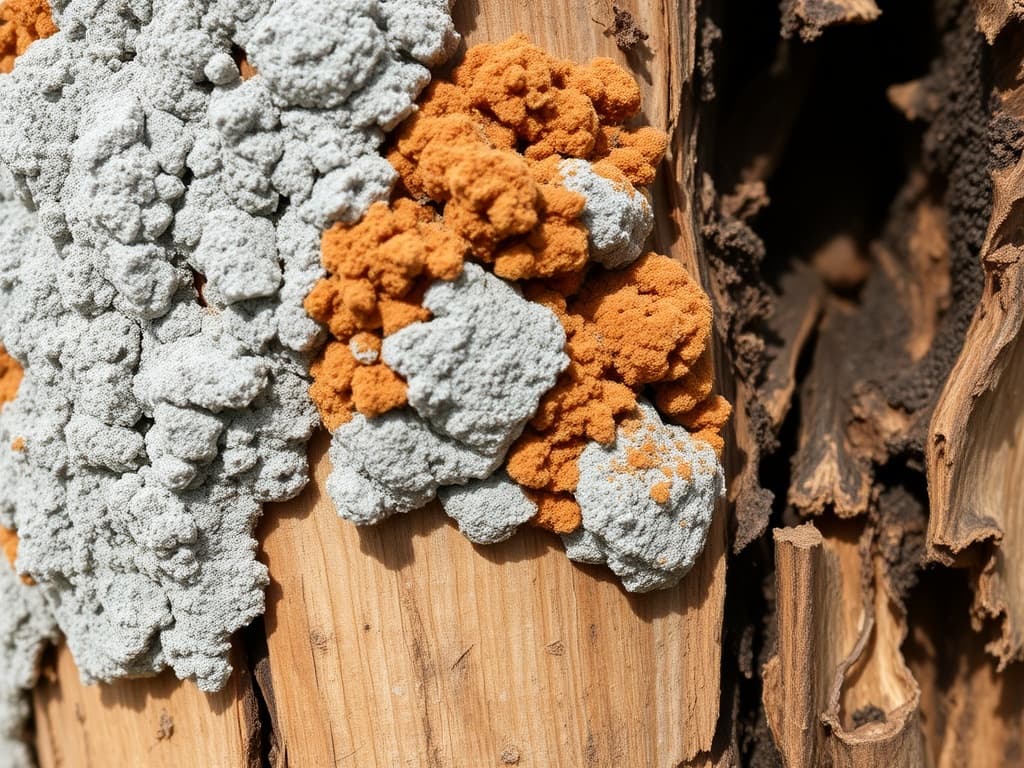
Robert H. B., Jr. / Wikimedia Commons / CC BY-SA 3.0
HYPOXYLON CANKER
What It Looks Like
- Gray or brown crusty patches on bark surface
- Dusty, powdery spore masses (cinnamon or silver-gray)
- Bark sloughing away in sheets revealing dark tissue beneath
Stress-triggered opportunistic fungus (Hypoxylon atropunctatum); attacks oaks and hackberries weakened by drought, construction damage, or soil compaction
What Happens If Ignored
Tree death is certain once established — no chemical treatment exists. Infected wood becomes brittle and failure risk escalates rapidly.
Recommended Action
Call an arborist immediately. If confirmed, removal is the only option. Do not wait for the tree to "recover."
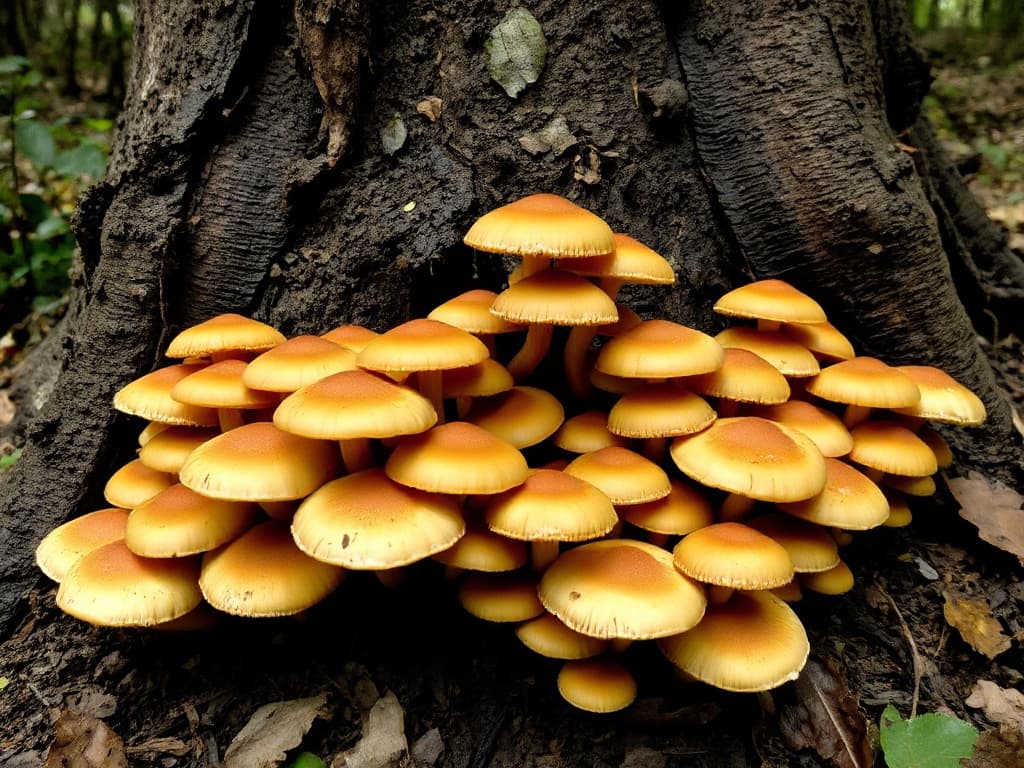
Wilhelm.zithol / Wikimedia Commons / CC BY-SA 3.0
ARMILLARIA ROOT ROT (SHOESTRING ROT)
What It Looks Like
- White fan-shaped mycelium sheets under bark at tree base
- Honey-colored mushroom clusters at roots or base in fall
- Bark may feel soft or water-soaked at soil line
Armillaria mellea fungus spreads through root contact and infected soil; kills feeder and anchor roots silently over years
What Happens If Ignored
Root system collapses without warning. A tree that looks healthy can uproot completely in a moderate storm once anchor roots are gone.
Recommended Action
Professional assessment required. Confirm with a certified arborist — affected trees near structures should be removed.
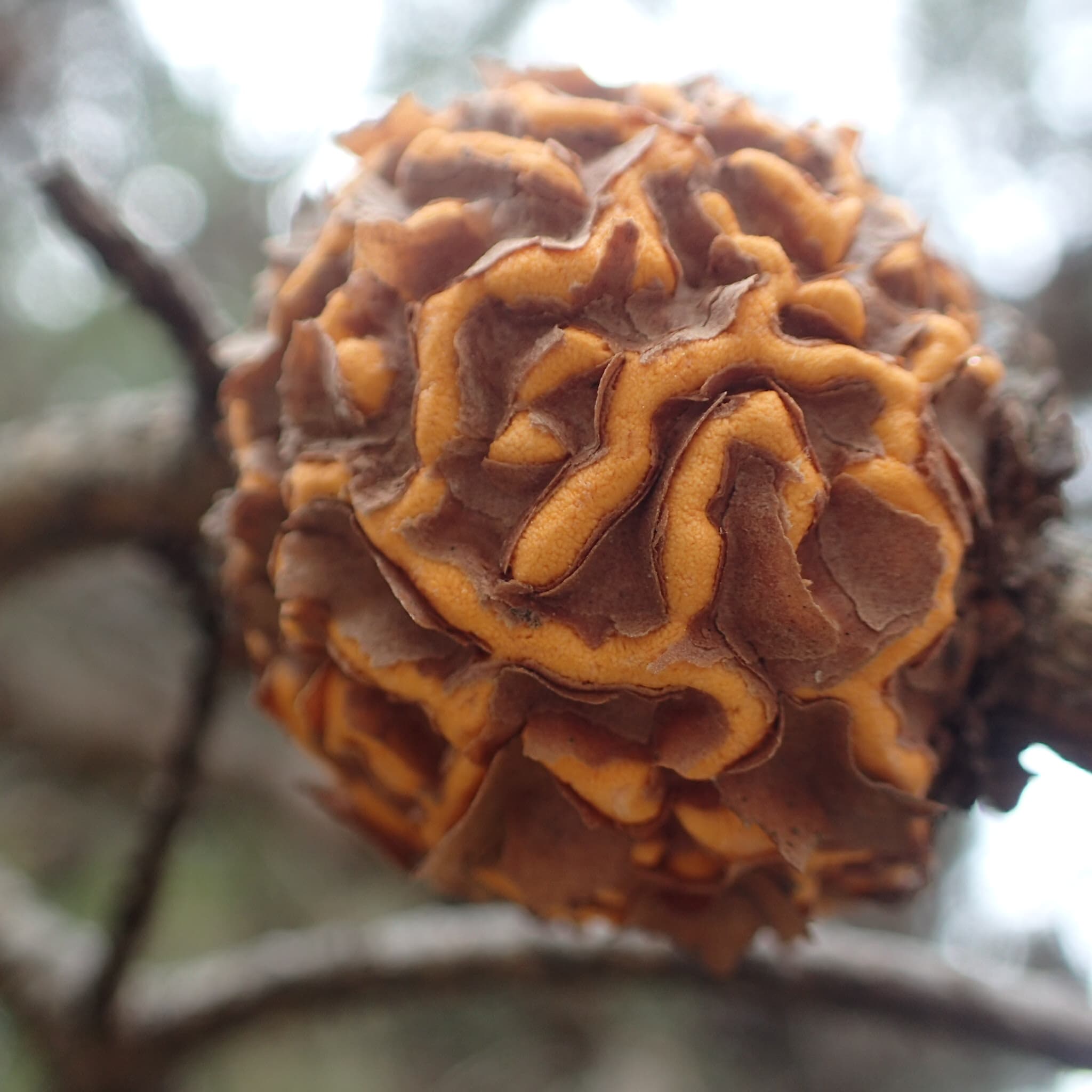
James A. Chatfield / Ohio State University / Wikimedia Commons / CC BY-SA 3.0
FUSIFORM RUST
What It Looks Like
- Orange or yellow spindle-shaped galls on pine branches or main stem
- Stem swelling and distortion at gall location
- Canopy thinning above the gall
Cronartium quercuum f. sp. fusiforme fungus; common in GA loblolly pine; alternates between pine and oak hosts
What Happens If Ignored
Galls on the main stem cause severe structural weakening — trunk can snap at the gall under wind or ice load.
Recommended Action
Have a certified arborist assess gall location. Main-stem galls on pines within falling distance of structures typically warrant removal.
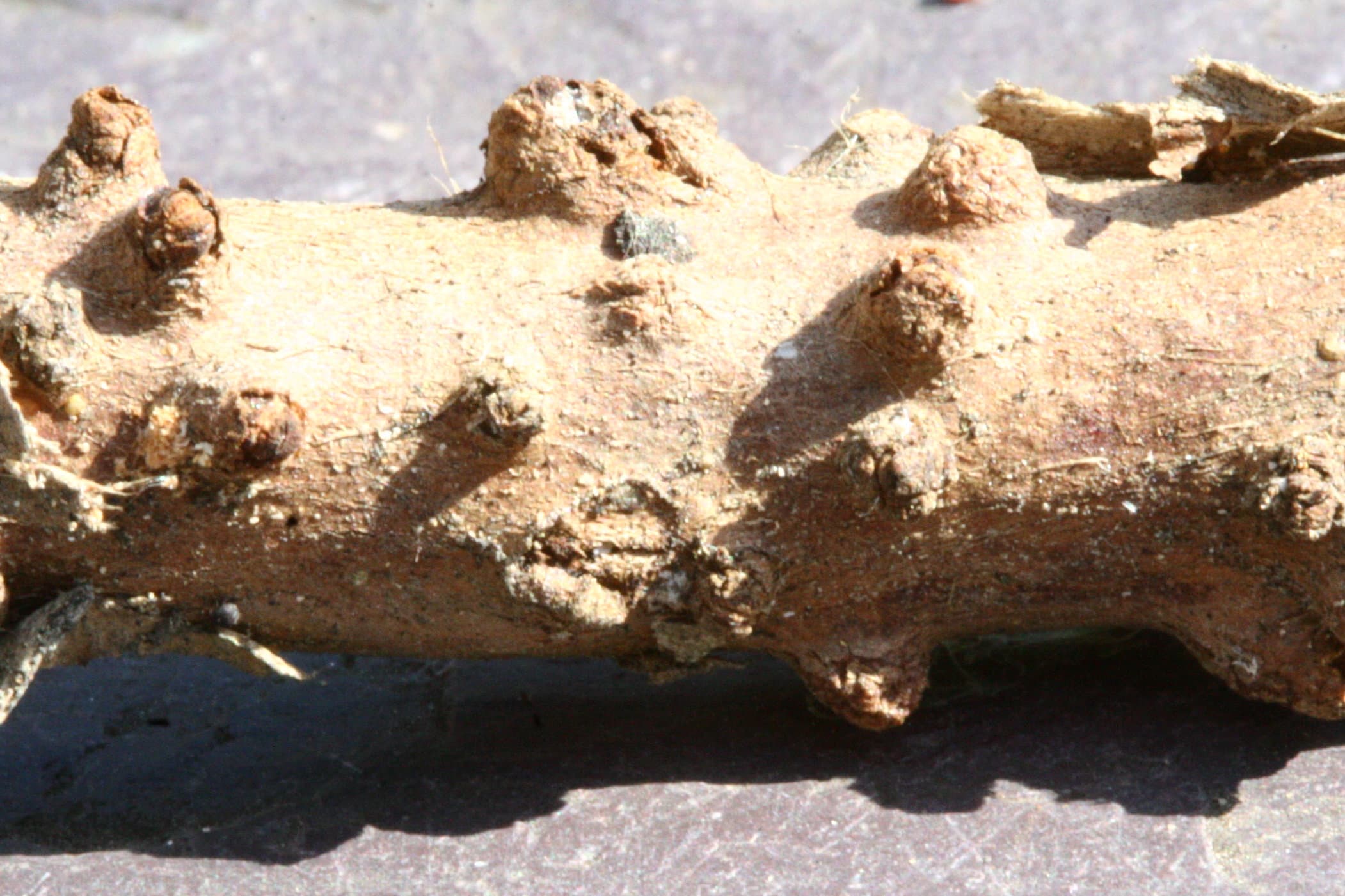
F. D. Rich / Wikimedia Commons / CC BY-SA 3.0
SEIRIDIUM CANKER
What It Looks Like
- Branch dieback progressing from top down or center out on Leyland cypress
- Sunken, resin-soaked dark lesions on cankered branches
- Brown dead foliage interspersed among green — "flagging" pattern
Seiridium cardinale fungus; no chemical cure exists; spreads rapidly in dense plantings
What Happens If Ignored
Progressive dieback kills the entire tree. Infected trees become fire hazards and structural failures within 1–3 seasons.
Recommended Action
Prune and destroy cankered material immediately. If more than 30% of canopy is affected, removal is recommended. Do not compost cankered wood.
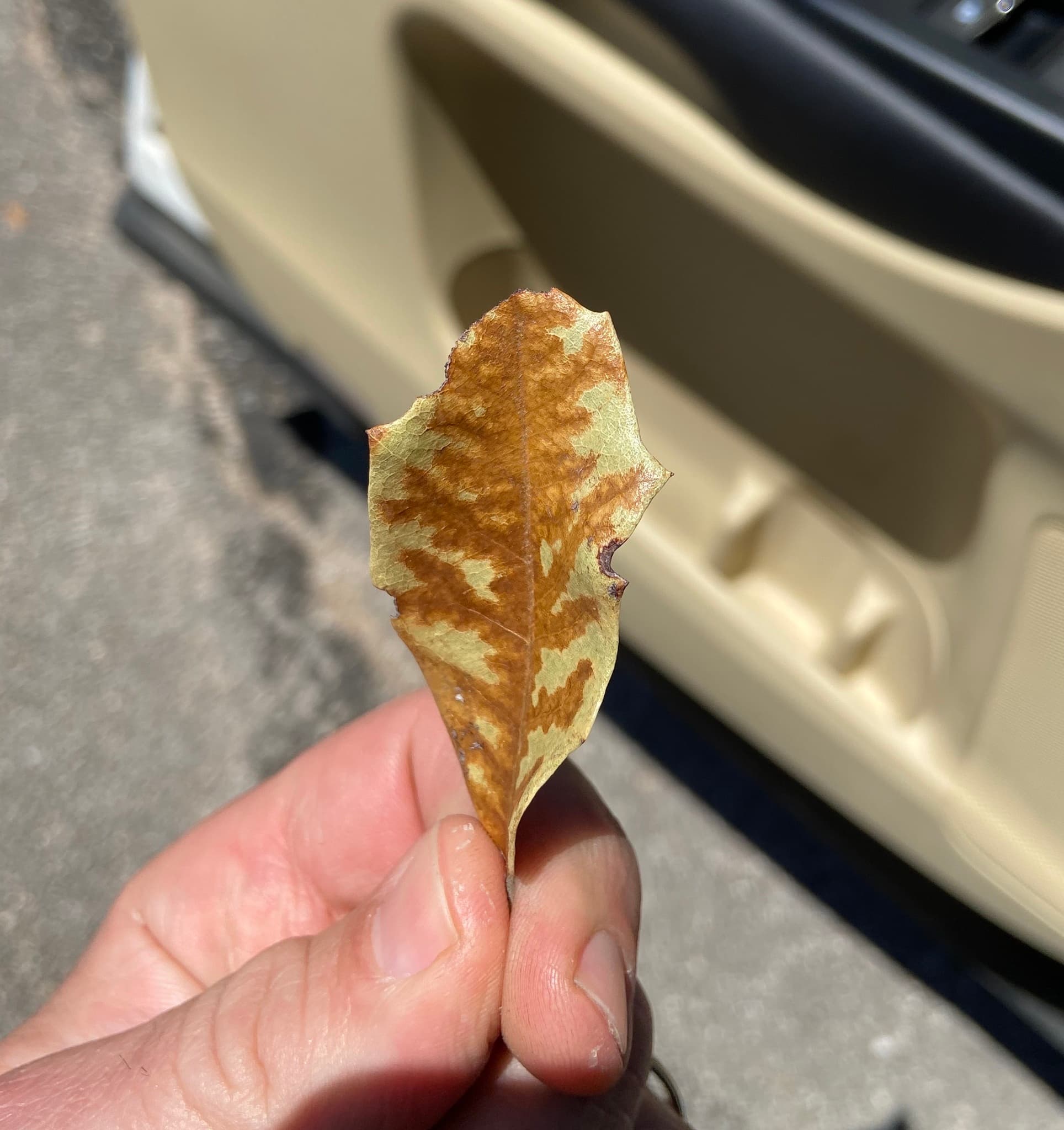
Michigan State University IPFL / Wikimedia Commons / CC BY-SA 3.0
OAK WILT (WATCH FOR)
What It Looks Like
- Rapid browning of leaves from the outer crown inward
- Leaves drop while still green or partially green
- Browning progresses down from crown in red oaks within weeks
Ceratocystis fagacearum fungus; spreads through root grafts between adjacent oaks and by sap beetles; not confirmed in GA but has been detected in neighboring states
What Happens If Ignored
Red oaks can die within weeks of infection. Entire stands connected by root grafts can be killed sequentially.
Recommended Action
Oak Wilt is not currently confirmed in Georgia, but watch for rapid crown browning in red oaks between April–July. Report suspicious cases to your local arborist immediately for lab testing.
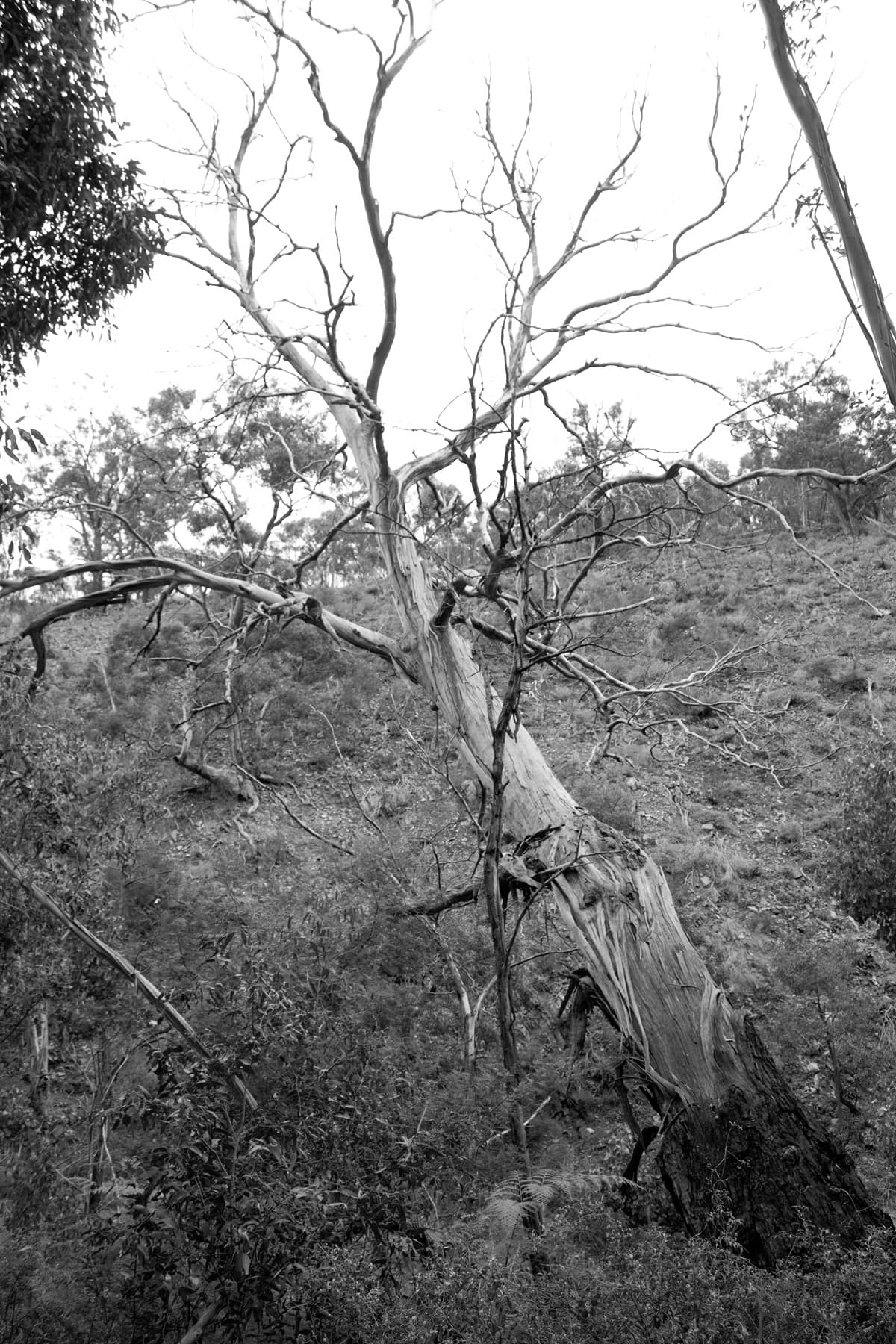
USDA Forest Service / Wikimedia Commons / Public Domain
CROWN DIEBACK
What It Looks Like
- Bare, dead branches in upper canopy while lower branches remain leafed
- Progressively thinning canopy over multiple seasons
- Small, undersized leaves or early fall color in the top third of the tree
Symptom of multiple stressors: root damage, vascular disease, soil compaction, grade change, construction disturbance, or drought; signals systemic decline
What Happens If Ignored
Structural integrity degrades as dead wood accumulates in the upper canopy. Major limb failures become increasingly likely, and the underlying cause typically continues advancing.
Recommended Action
Professional assessment to diagnose root cause. Dead wood removal reduces immediate hazard. Decline may be irreversible depending on cause.
FIRE BLIGHT
What It Looks Like
- Shoot tips wilting and curling into a "shepherd's crook" shape
- Brown-black blighted wood with water-soaked bark at the margin
- Affects crabapple, pear, apple, hawthorn, serviceberry, and pyracantha
Bacterial disease (Erwinia amylovora); spreads rapidly through blossoms and wounds during warm, wet spring weather; no cure once systemic
What Happens If Ignored
Fire blight progresses from shoot tips down into scaffold limbs and the main stem. In susceptible ornamental pears and crabapples, systemic infection can kill the tree within one to two seasons.
Recommended Action
Prune 8–12 inches below visible infection into healthy wood; sterilize tools between cuts with 10% bleach solution. Severely infected trees should be assessed by a certified arborist. Do not compost blighted material.
PHYTOPHTHORA ROOT ROT
What It Looks Like
- Dark, water-soaked discoloration at the root collar or crown
- Bark at the soil line may crack or peel to reveal dead, reddish-brown inner tissue
- Crown dieback and small yellowing leaves despite adequate soil moisture
Phytophthora cinnamomi and related water molds; thrive in poorly-drained, consistently wet soils; damage is most severe in heavy clay — common throughout Cobb County
What Happens If Ignored
Root and collar decay spreads upward into the main stem. Infected trees lose structural root support silently over years before showing obvious crown symptoms — whole-tree failure can occur with little warning.
Recommended Action
Improve drainage around the root zone; avoid excessive mulching against the trunk. Have a certified arborist assess root collar health. Phosphonate fungicide soil drenches can slow progression in early-stage infections.
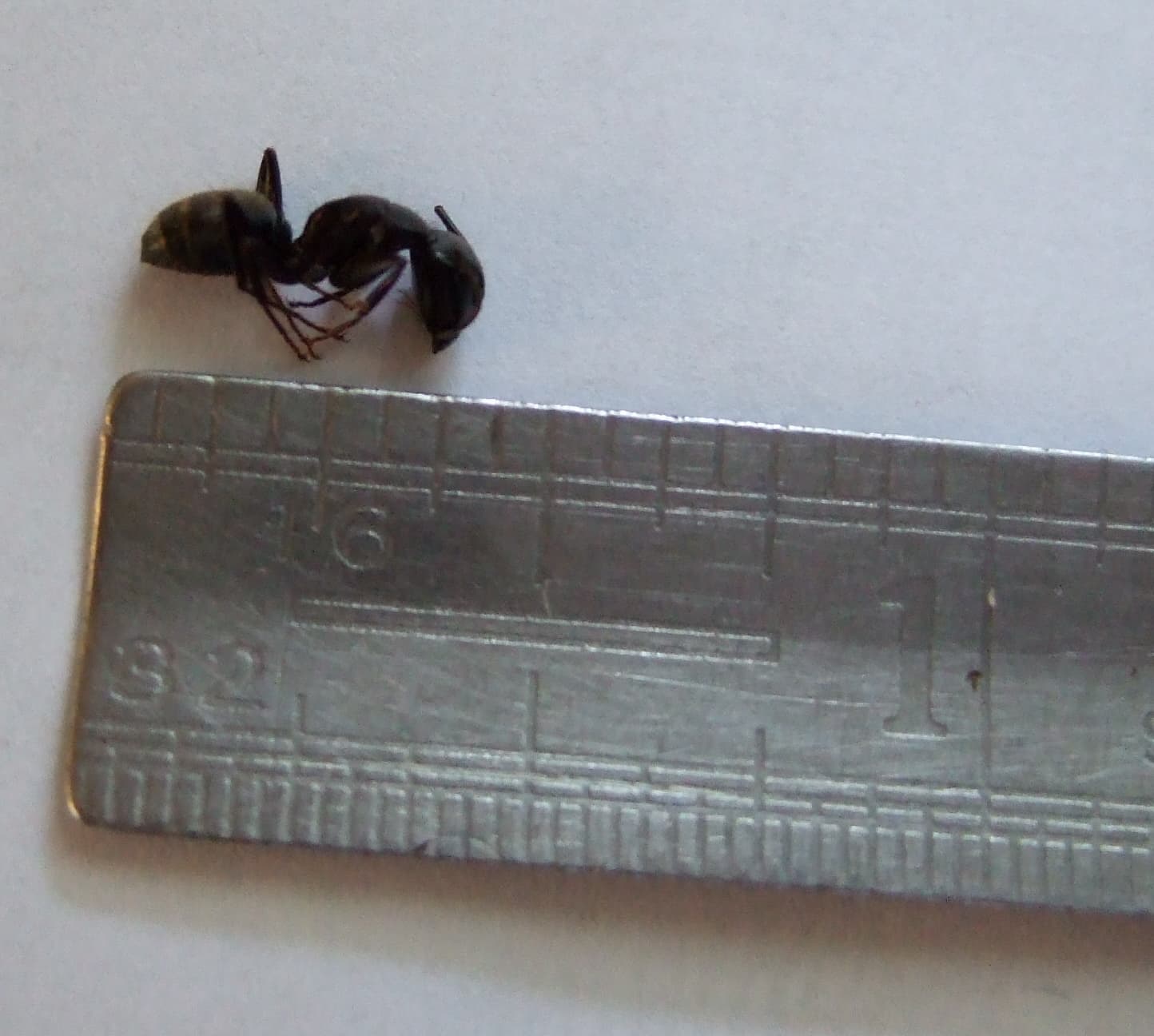
Ulrich L. / Wikimedia Commons / CC BY-SA 3.0
CARPENTER ANT ACTIVITY
What It Looks Like
- Large black ants (3/4 inch or more) entering/exiting holes in trunk
- Coarse sawdust-like frass at base or in bark crevices
- Soft or hollow sound when trunk is tapped
Carpenter ants nest in pre-existing decay cavities — they do not cause rot but are a reliable indicator that internal wood decay is already present
What Happens If Ignored
The decay cavity causing ant activity will continue to expand. Structural shell thickness decreases until the trunk can no longer support the canopy load.
Recommended Action
Treat the ants as a warning signal, not the actual problem. Have a certified arborist assess the extent of internal decay before the next storm season.
TREE PESTS & INVASIVE INSECTS
Bark beetles, invasive borers, and sap-feeding insects can kill trees in weeks — or slowly weaken them over years before the damage becomes visible. Many of these pests are federally regulated; early detection and reporting can slow their spread.
SOUTHERN PINE BEETLE
Dendroctonus frontalis
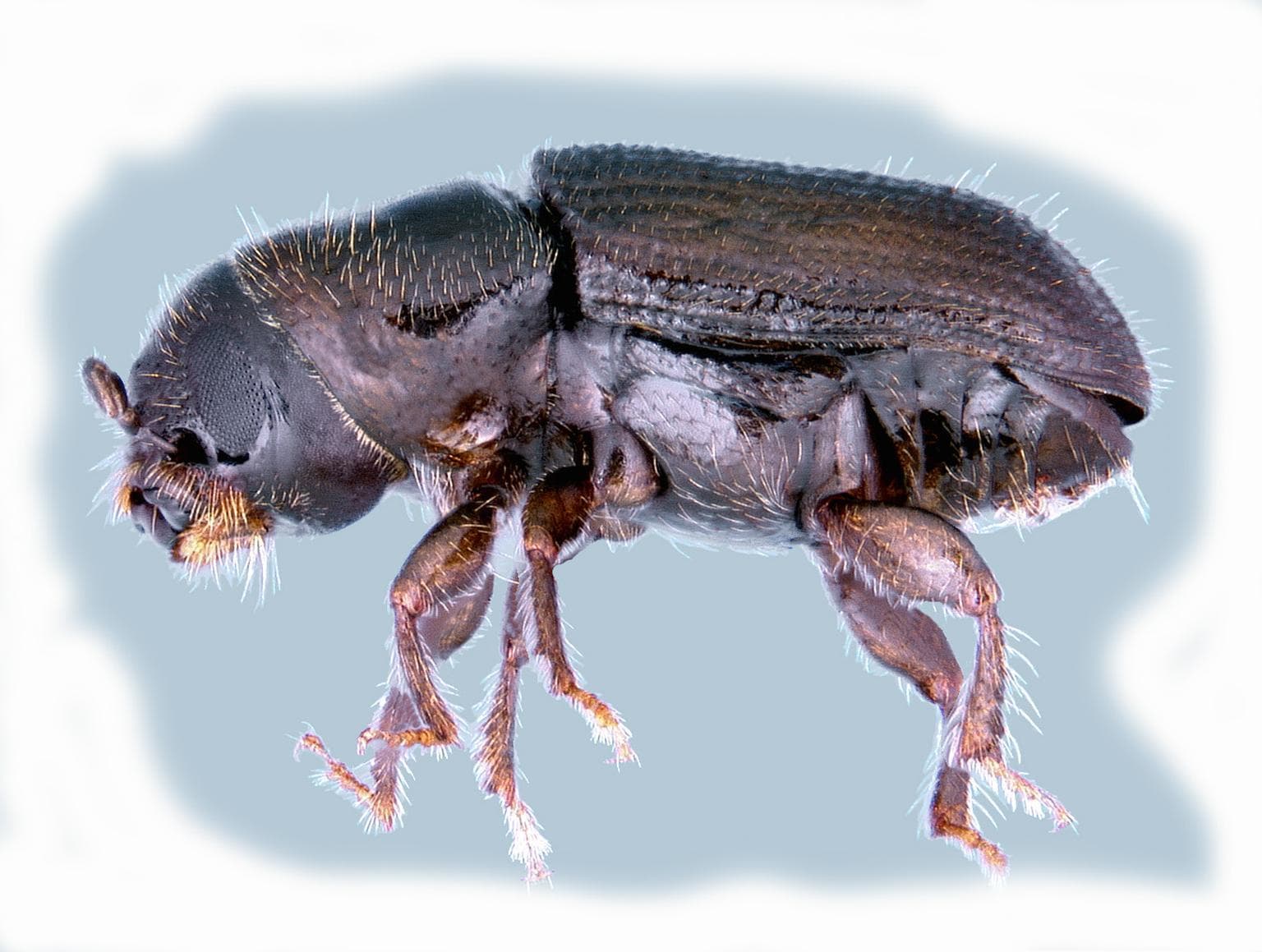
Adult beetle — actual size 2–4 mm
Photo credits: Erich G. Vallery / Wikimedia Commons / CC BY 3.0
Host Trees
Loblolly Pine, Shortleaf Pine, Slash Pine, Virginia Pine
How to Identify It
- Small (2–4 mm), reddish-brown to black bark beetle — roughly the size of a grain of rice
- Pitch tubes (small, white to yellow popcorn-like resin masses) on trunk bark
- S-shaped or sinuous egg galleries under the bark, packed with sawdust-like frass
- Fading, yellowing crown that progresses from top down to red-brown
- Woodpecker feeding holes in the outer bark, scaling bark flaps away from trunk
One of the most destructive forest insects in the southeastern United States. SPB mass-attacks stressed and healthy pines, girdling the phloem and introducing a blue-stain fungus that blocks water transport. Trees can die within 2–4 weeks of a successful attack. Outbreaks kill entire groups of pines — "spots" visible from the air — often triggered by drought, lightning, or ice storm stress.
Life Cycle
SPB completes 5–7 generations per year in Georgia. Adults bore through bark to lay eggs; larvae feed in the phloem layer, creating the diagnostic S-shaped galleries. New adults emerge and immediately attack adjacent trees. A small outbreak can expand into hundreds of trees within a single season.
What Happens If Ignored
A single infested tree typically triggers a "spot" that expands to neighboring pines. Left unchecked, an SPB spot can kill dozens to hundreds of trees in one season. Dead pines create extreme fire and hazard wood risk.
Recommended Action
Act fast — SPB spreads rapidly. Have a certified arborist confirm SPB identification (pitch tubes + S-galleries under bark). Salvage removal of infested trees before adult emergence breaks the cycle. Do not leave infested slash on site. Report significant outbreaks to the Georgia Forestry Commission.
HEMLOCK WOOLLY ADELGID
Adelges tsugae
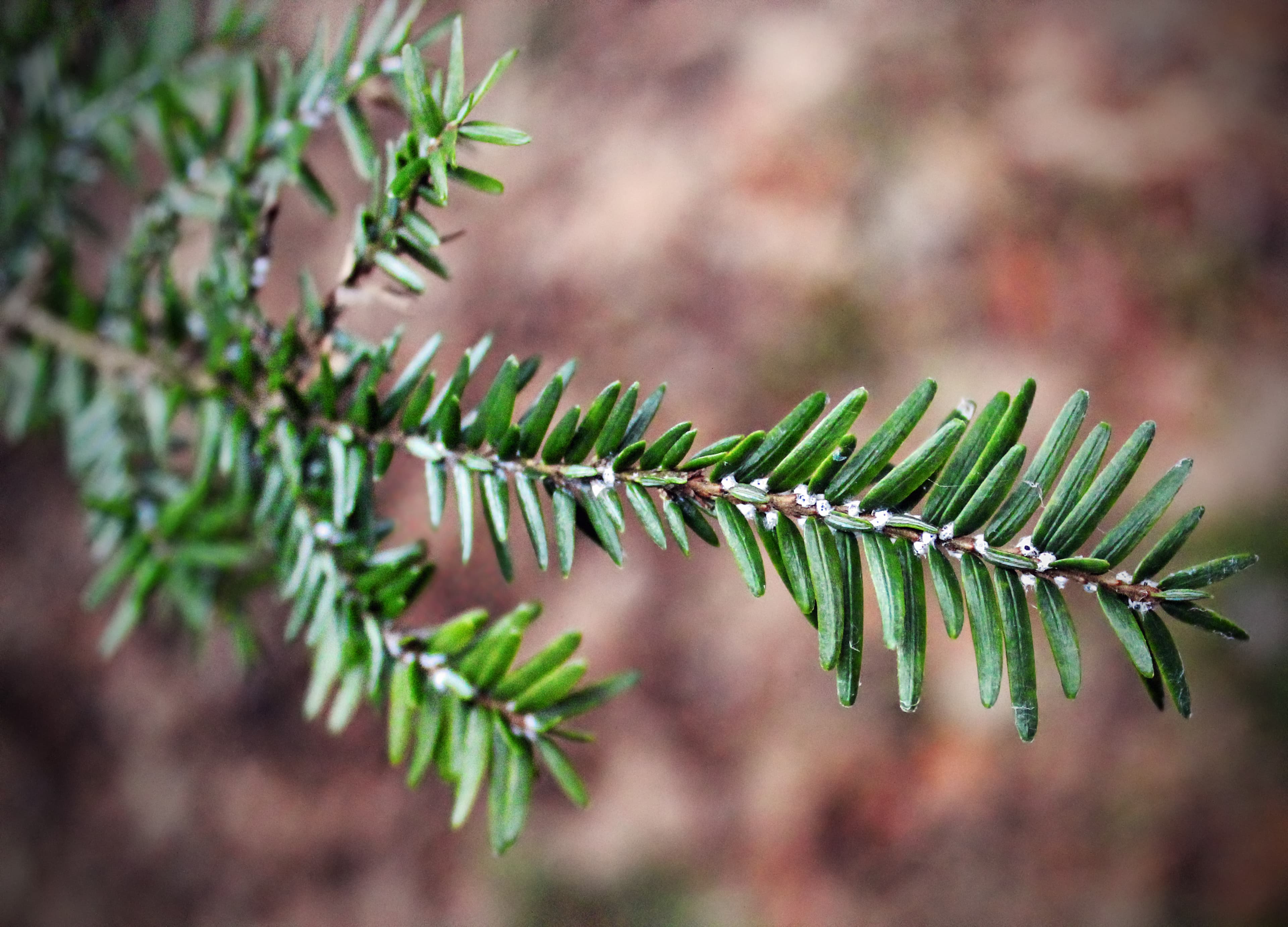
White woolly masses at needle bases — the diagnostic sign
Photo credits: Nicholas A. Tonelli from Northeast Pennsylvania, USA / Wikimedia Commons / CC BY 2.0
Host Trees
Eastern Hemlock, Carolina Hemlock
How to Identify It
- Tiny (1.5 mm) soft-bodied insects hidden under white, cottony woolly masses at base of needles
- Woolly masses most visible on the underside of hemlock branches October–June
- Needle drop, needle grayish discoloration, and branch dieback from the bottom of the crown upward
- Heavily infested hemlocks display sparse, grayish-green foliage with significant needle loss
HWA is an invasive insect from Asia that feeds on hemlock sap, injecting a toxic saliva that prevents new bud set. Eastern hemlock — the "redwood of the East" and a keystone species in North Georgia mountain streams — has no natural resistance. Without treatment, infested trees typically die within 4–10 years. HWA has already killed or is threatening millions of hemlocks across the Appalachian range.
Life Cycle
Two generations per year: a "sistens" generation (overwintering on hemlock needles from October–June) and a "progrediens" generation (spring–summer). The sistens generation is the most visible and damaging. HWA spreads by wind, birds, deer, and human movement of infested plant material.
What Happens If Ignored
Death of the tree is essentially certain without treatment. Loss of Eastern hemlock from Georgia mountain streams causes dramatic ecological cascade: loss of year-round shading, stream temperature rise, loss of cold-water fish habitat.
Recommended Action
Treatment is effective if caught early. Systemic insecticide soil injection (imidacloprid or dinotefuran) by a licensed arborist protects trees for several years per application. Don't wait — trees in decline respond poorly. Report new infestations away from known zones to the Georgia Forestry Commission.
SPONGY MOTH
Lymantria dispar dispar
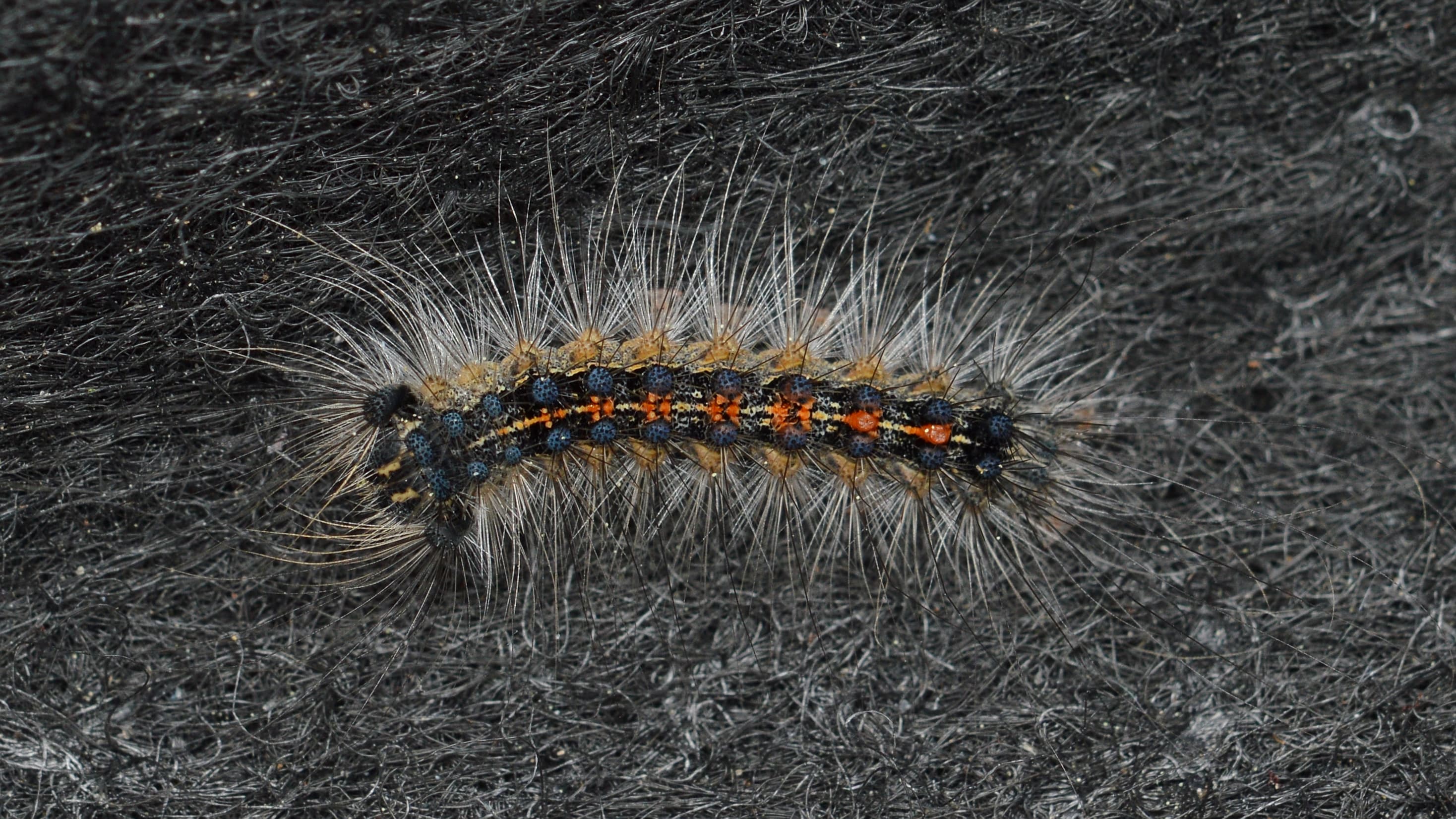
Caterpillar: blue spots (front), red spots (rear) — 2.5 inches at maturity
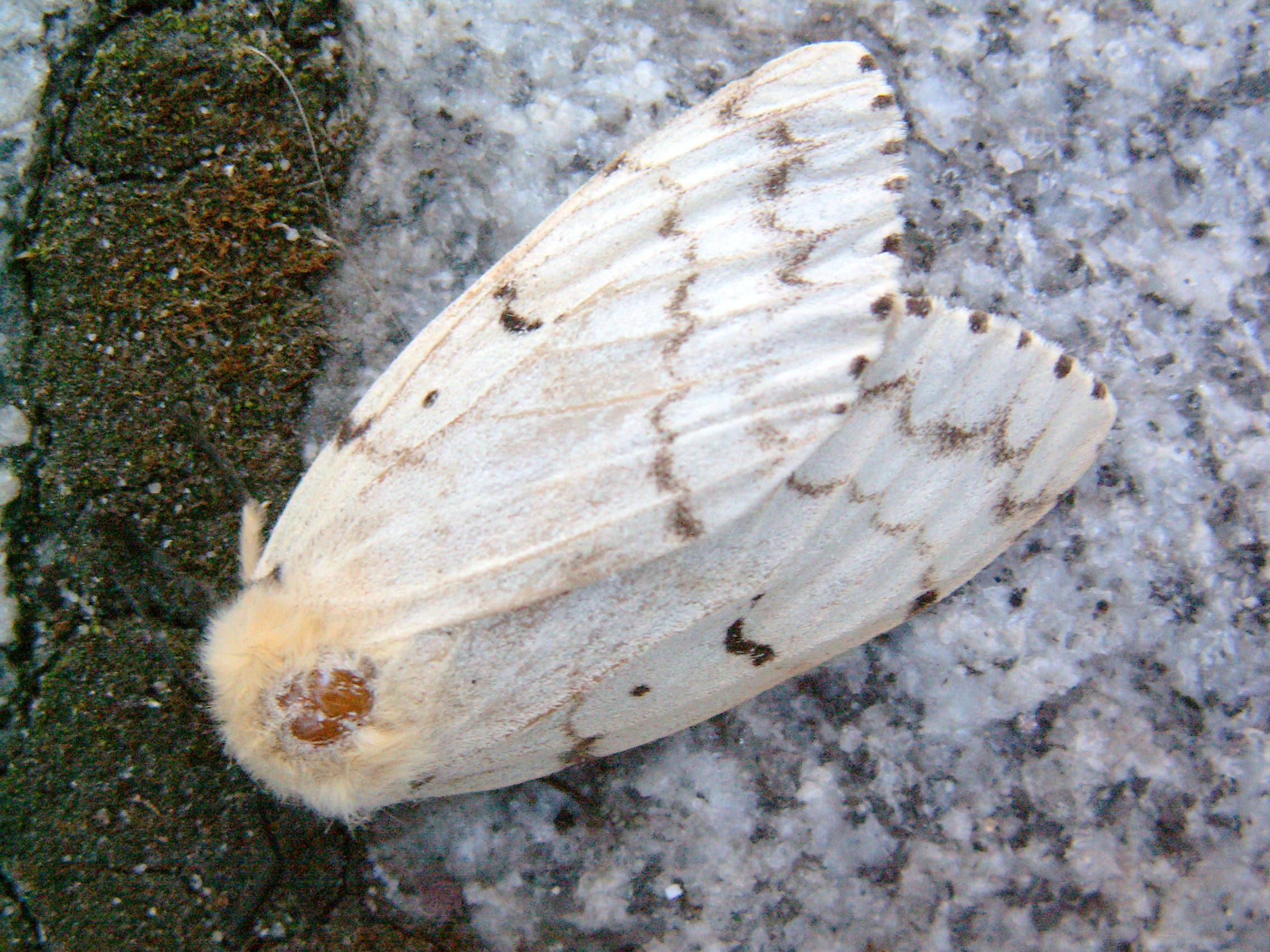
Adult male moth — females are whitish and do not fly
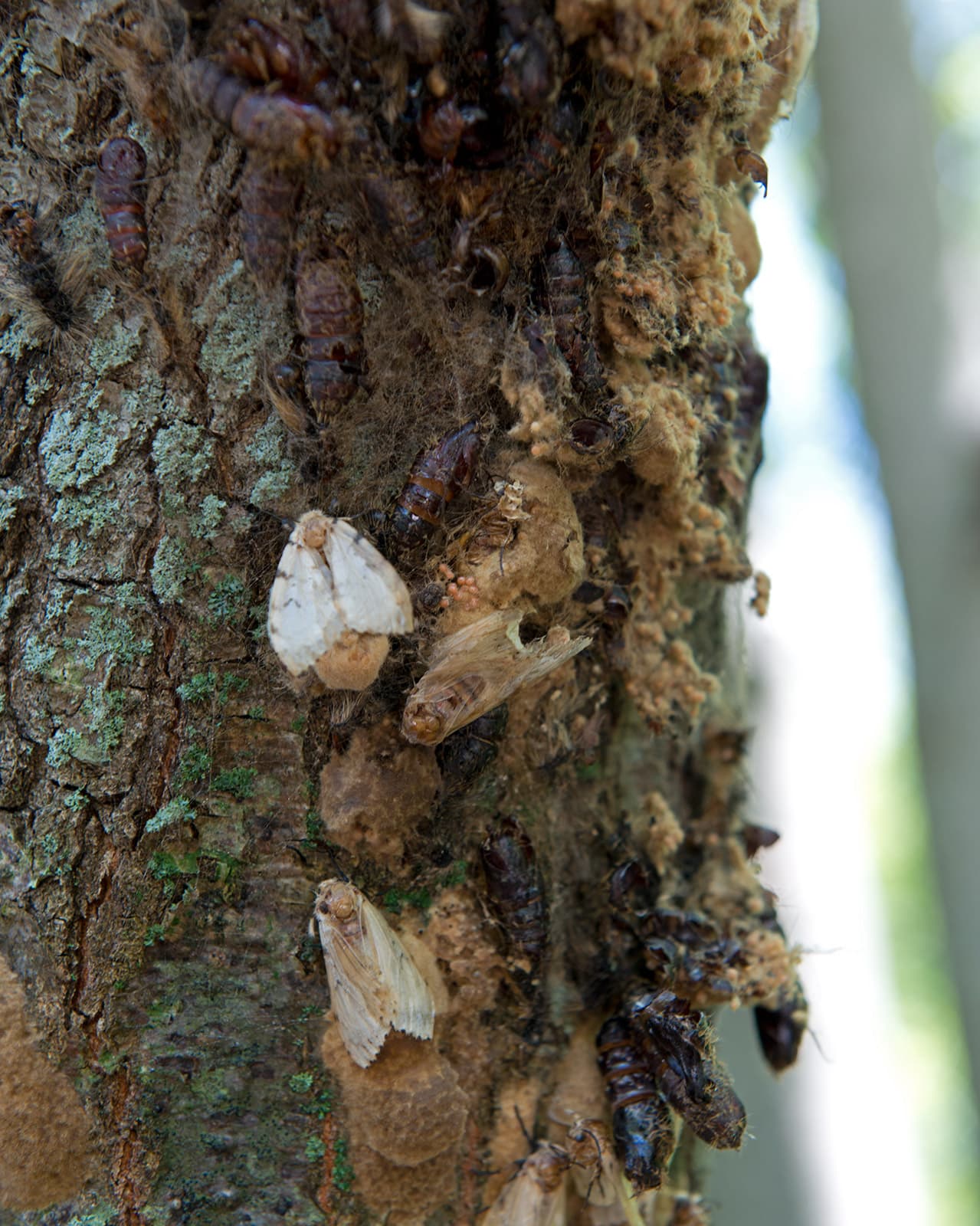
Female moth — lays buff-colored, hairy egg masses on bark
Photo credits: Ryan Hodnett / Wikimedia Commons / CC BY-SA 4.0 | Plant Image Library / Wikimedia Commons / CC BY-SA 2.0 | Opuntia / Wikimedia Commons / CC BY-SA 3.0
Host Trees
Oak (all species), Apple, Birch, Poplar, Maple, Sweetgum
How to Identify It
- Caterpillars up to 2.5 inches long with distinctive blue and red spots along the back in two rows
- Large, hairy tan or buff egg masses (the size of a quarter to a half-dollar) on tree bark, rocks, outdoor furniture — covered in dense, buff-colored hairs
- Defoliation of entire trees beginning in late April–June; characteristic "dripping" of frass (caterpillar droppings) below infested trees
- Adult male moths: tan-brown with darker wavy bands; female moths: larger, whitish, and typically do not fly
Spongy moth caterpillars are voracious defoliators, capable of completely stripping oaks and other hardwoods in a single season. One or two defoliation events weaken trees significantly; repeated defoliation kills them. Oak species are especially vulnerable — a single major outbreak can kill large percentages of oaks in affected stands. The pest is currently established in the northeastern U.S. and spreading southward.
Life Cycle
One generation per year. Egg masses overwinter on any hard surface and hatch in spring (April–May in Georgia). Caterpillars feed through June; pupate in July. Adult moths emerge in July–August; females lay egg masses immediately after mating. Egg masses are the primary means of long-distance spread via accidental transport on vehicles, firewood, and outdoor gear.
What Happens If Ignored
Repeated complete defoliation kills oaks over 2–4 years. A spongy moth outbreak affecting a wooded lot can kill most of the mature oaks — removing decades of established trees and dramatically increasing property hazard risk.
Recommended Action
Spongy moth is not yet established in Georgia but is spreading southward. If you find egg masses on bark or outdoor items that came from infested states (Northeast, Midwest), scrape and destroy them into soapy water. Report suspect sightings to the Georgia Department of Agriculture. Do not move firewood from infested areas.
REDBAY AMBROSIA BEETLE & LAUREL WILT
Xyleborus glabratus / Raffaelea lauricola
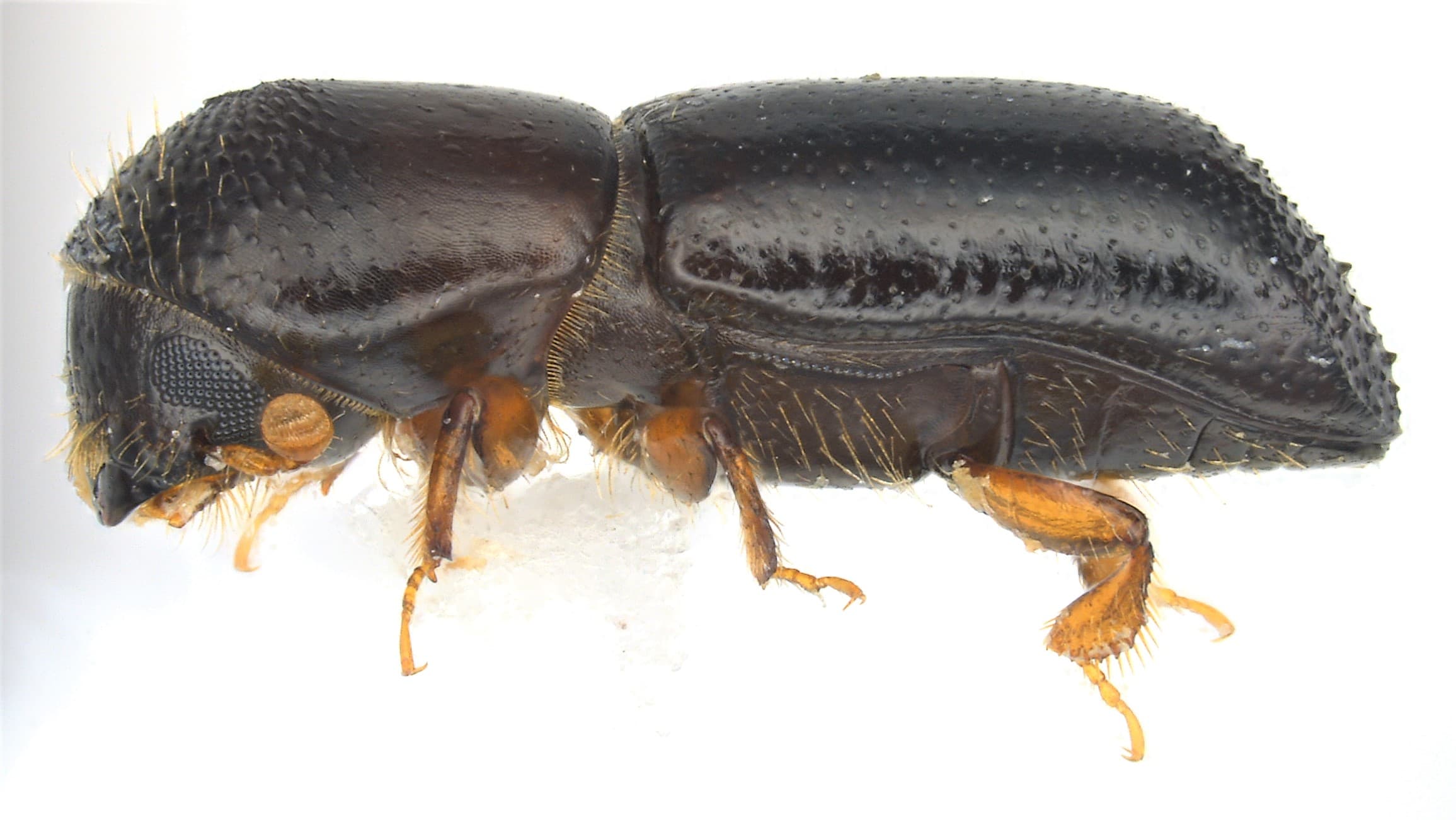
Redbay ambrosia beetle — actual size approximately 2 mm
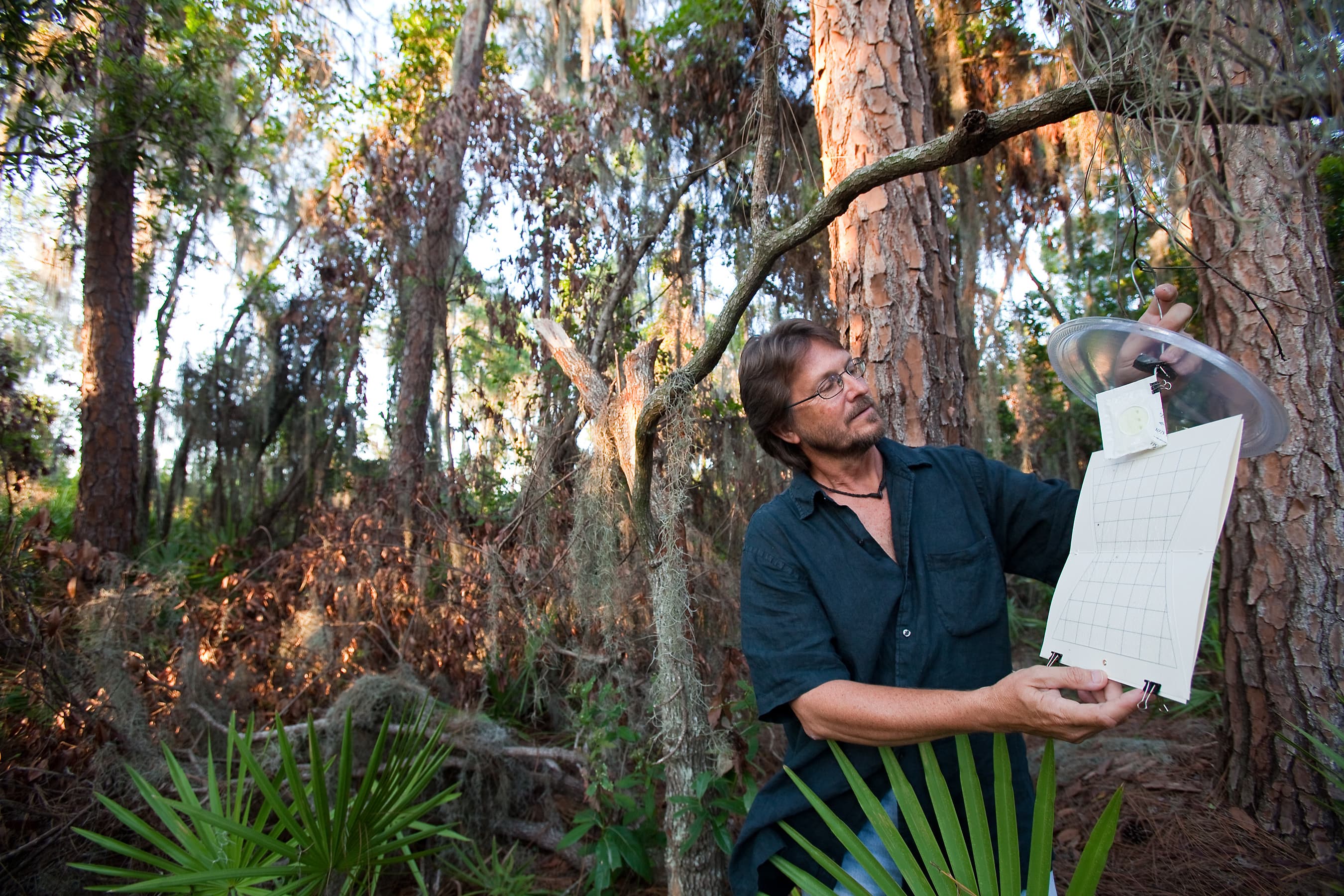
USDA monitoring traps used to detect and track the beetle's spread
Photo credits: Eickwort / Wikimedia Commons / CC BY-SA 4.0 | U.S. Department of Agriculture / Wikimedia Commons / CC BY 2.0
Host Trees
Redbay, Sassafras, Swamp Bay, Silk Bay, Avocado (commercial)
How to Identify It
- Small (2 mm), dark brown to black ambrosia beetle — roughly the size of a sesame seed
- Toothpick-like tubes of white or yellowish frass projecting from pinhole-sized entry holes in bark
- Sudden wilting of entire branches or whole tree crown — leaves turn brown while still attached
- Dark brown to black streaking in the sapwood and phloem visible when bark is cut
- Characteristic sweet or spicy odor from affected wood of sassafras and redbay
The Redbay Ambrosia Beetle vectors Laurel Wilt disease (the fungus Raffaelea lauricola), which blocks water transport in the sapwood, causing rapid wilt and death. Redbay and sassafras — critical understory species and essential habitat trees — die within weeks of infection. No effective treatment exists once a tree is infected. Laurel Wilt has killed hundreds of millions of redbay trees across the Southeast and is spreading westward. In Georgia's coastal plain and piedmont, this beetle-fungus complex is one of the most ecologically destructive pest events of the past 20 years.
Life Cycle
The beetle breeds in infested wood, carrying the pathogenic fungus in specialized structures (mycangia). After boring through bark, it inoculates the tree with the fungus. New adults emerge and fly to attack additional trees. The fungus spreads through root grafts between adjacent trees of the same species, even without beetle involvement. Range expansion follows both beetle flight and human movement of infested firewood or logs.
What Happens If Ignored
Infected trees die within weeks and cannot be saved. Adjacent redbays and sassafras connected by root grafts often die in sequence. Entire populations of native laurel-family trees can be eliminated from a property or woodland.
Recommended Action
There is no treatment for infected trees. Remove and chip infested material to prevent beetle emergence and spread. Do not move logs or firewood from affected areas. Report new occurrences of wilted sassafras or redbay to the Georgia Department of Agriculture — tracking the spread is critical.
SIREX WOODWASP
Sirex noctilio
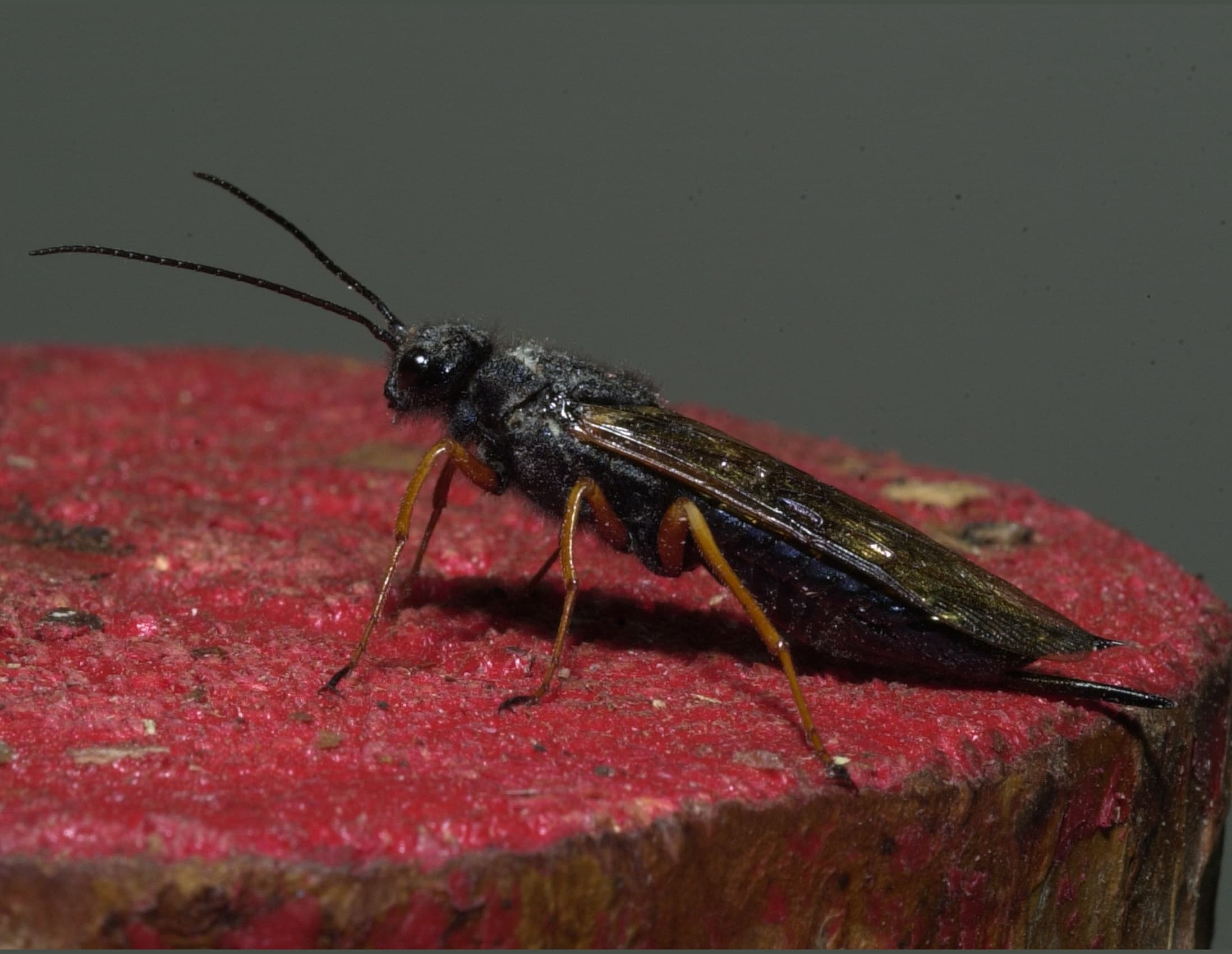
Adult female — up to 38 mm long, steel-blue body with orange legs
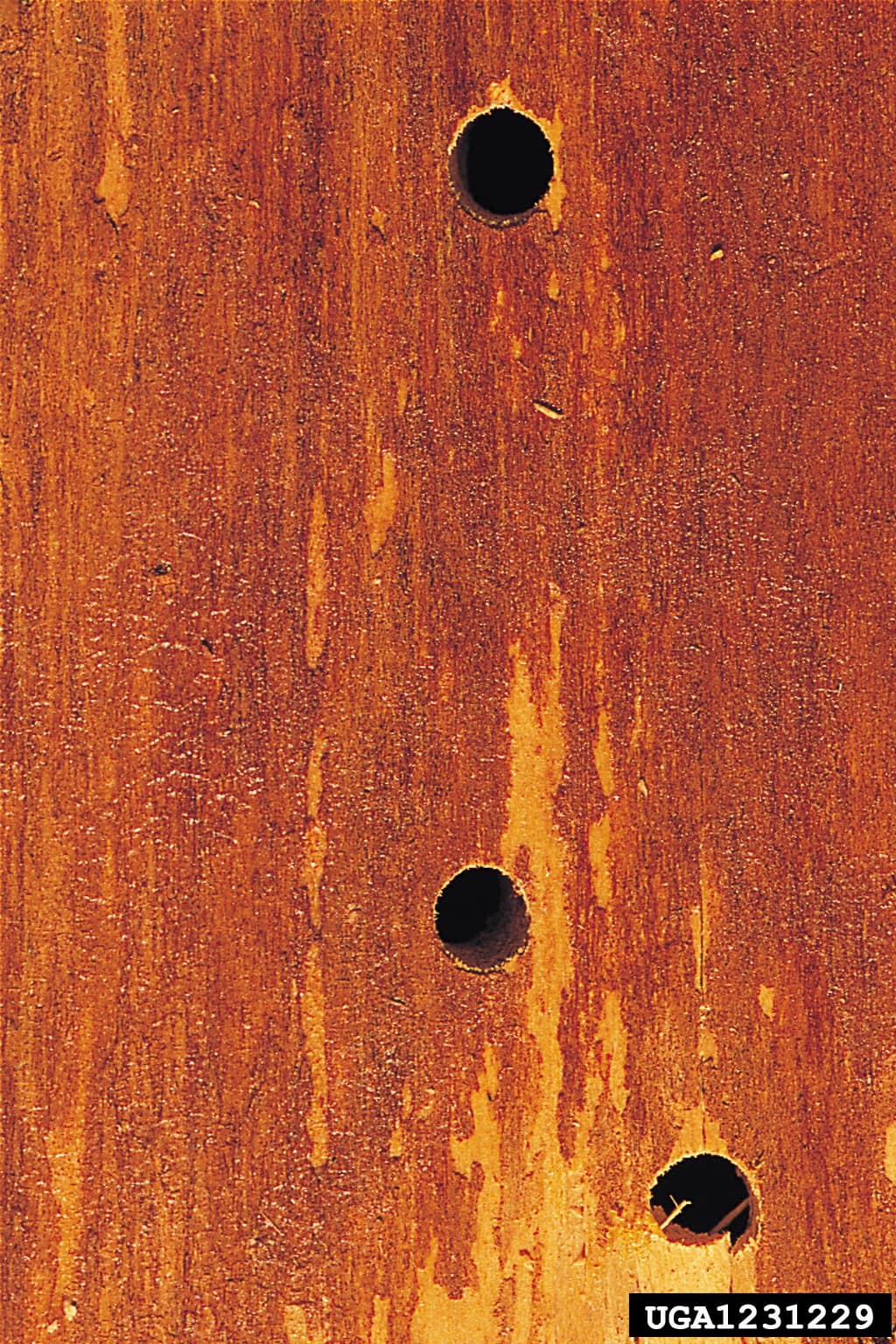
Circular exit holes — 5–8 mm diameter — diagnostic for Sirex emergence
Photo credits: David R. Lance, USDA APHIS PPQ / Wikimedia Commons / CC BY 3.0 | Gyorgy Csoka, Hungary Forest Research Institute / Wikimedia Commons / CC BY 3.0
Host Trees
Loblolly Pine, Slash Pine, Shortleaf Pine, All Southern pines
How to Identify It
- Large (10–38 mm), steel-blue to black body with orange legs — a striking, wasp-like appearance
- Female has a prominent, spike-like ovipositor at the tail; males have an orange abdomen
- Perfectly round, 5–8 mm exit holes in pine bark when adults emerge
- Yellowish resin ooze from oviposition wounds on stressed or infested trees
- Crown fade and needle drop in pine patches during late summer and fall
Sirex noctilio is an invasive woodwasp native to Eurasia and Africa. Female wasps inject a toxic mucus and a wood-rotting fungus (Amylostereum areolatum) into pine sapwood during egg-laying. Together, the mucus and fungus disrupt water transport in the sapwood. Stressed pines — weakened by drought, southern pine beetle, or other factors — are most vulnerable. In its native range it is not a major pest; in new environments (South America, Australia, New Zealand), it has killed tens of millions of pines. First detected in the U.S. in New York in 2004; confirmed spreading. Not yet confirmed in Georgia but high-priority watch pest.
Life Cycle
One generation per year. Adults emerge in late summer and fall. Females drill into stressed pine bark to lay eggs, inoculating the tree with fungal spores simultaneously. Larvae develop inside the wood for 1–2 years; pupate near the surface; adults chew perfectly circular exit holes. Attack preference is stressed trees — Sirex is often described as a "stressor-amplifier."
What Happens If Ignored
In outbreak conditions, Sirex can kill 30–80% of trees in a pine stand within 2–3 years. Combined with Southern Pine Beetle pressure, the impact on Georgia's loblolly pine forests could be severe.
Recommended Action
Learn to recognize the round exit holes and large blue-black wasp. If you find large metallic-blue wasps in pine areas with crown fade, photograph the insect and the tree symptoms and report immediately. Do not move pine logs, lumber, or firewood that may harbor larvae. Maintain tree health through proper irrigation and soil aeration to reduce stress susceptibility.
PINE WILT DISEASE
Bursaphelenchus xylophilus (pine wilt nematode)
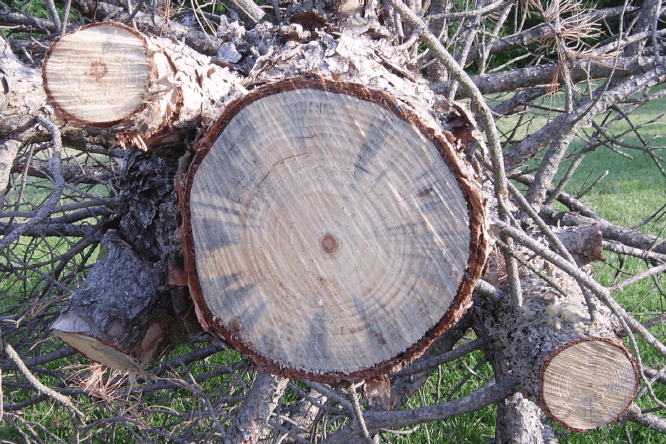
Cross-cut of pine killed by pine wilt — brown discoloration in the wood
Photo credits: Mateinsixtynine / Wikimedia Commons / CC BY-SA 3.0
Host Trees
Scots Pine (ornamental), Austrian Pine (ornamental), Japanese Black Pine, Mugo Pine
How to Identify It
- Sudden, rapid browning of needles — entire tree turns brown within weeks in summer
- Needles remain attached initially (unlike southern pine beetle, which causes needle drop)
- Tree shows no pitch tube or beetle emergence holes in early stages
- Most common in ornamental pine species, not native loblolly or shortleaf pines
- Resinous odor absent from affected wood despite rapid death
Pine wilt nematode (PWN) is a microscopic roundworm that rapidly colonizes and blocks the resin canals of susceptible pine species, cutting off water transport. It is vectored by pine sawyer beetles (Monochamus species) that carry the nematode in their bodies and introduce it during feeding on healthy pines. Death can occur in as little as 3–4 weeks in summer. Once introduced into a tree, the outcome is fatal — no treatment saves an infected tree. Native loblolly and longleaf pines generally have some resistance; ornamental species like Scots pine and Austrian pine are most vulnerable.
Life Cycle
PWN reproduces rapidly inside pine wood; populations can reach millions of individual nematodes within weeks. Beetle vectors pick up nematodes when feeding on infected wood and carry them to healthy trees during maturation feeding. The cycle repeats when beetles breed in dead wood.
What Happens If Ignored
Infected trees die within one season and cannot be saved. Infected dead wood continues to harbor nematodes and beetle vectors, creating an inoculum source that can spread to additional ornamental pines on neighboring properties.
Recommended Action
Remove and destroy (chip or burn) infected trees promptly — this eliminates the nematode reservoir and vector breeding habitat. Do not compost infected wood. There is no chemical injection treatment proven to save infected trees. For at-risk ornamental pines, maintain tree health with proper watering and mulching; avoid mechanical wounding that creates beetle entry points.
THOUSAND CANKERS DISEASE
Geosmithia morbida (fungus) / Pityophthorus juglandis (walnut twig beetle)
Host Trees
Black Walnut, Butternut
How to Identify It
- Yellowing or browning foliage that may look like drought stress or nutrient deficiency
- Tiny (1.5–2 mm) bark beetle entry holes in branches and upper trunk — smaller than a pencil tip
- Small, dark brown to black cankers (sunken dead areas) in the inner bark at each beetle entry point
- Branches die from the top of the crown downward ("flagging") over 2–4 years
- Hundreds to thousands of individual cankers can coalesce, girdling branches and the main stem
Thousand Cankers Disease is a beetle-fungus complex affecting black walnut. The tiny Walnut Twig Beetle bores into branches and introduces the fungus Geosmithia morbida. Each infection creates a small canker; with hundreds of attacks, cankers coalesce and girdle the tree. There is no effective treatment. Black walnut is an exceptionally high-value timber, nut, and landscape tree; its loss carries significant ecological and economic consequences. TCD is established in the western U.S. and has been confirmed moving eastward — confirmed in Tennessee and Pennsylvania.
Life Cycle
The walnut twig beetle produces 2–3 generations per year. Adults emerge and fly to new host trees, boring into thin-barked branches to lay eggs. The fungus enters with each boring. Larvae feed under the bark, extending the canker as they develop. The cycle of attack is relentless during warm months.
What Happens If Ignored
Infected trees decline and die over 3–10 years. There is no known cure. By the time visible crown symptoms appear, the canker damage is already extensive. Early detection and reporting are the primary tools for slowing the spread.
Recommended Action
Learn to identify the tiny bark beetle entry holes in walnut branches (use a hand lens — they are very small). If you have black walnut trees in your yard, inspect branches annually for entry holes and send photos to your local UGA Extension agent. Do NOT move walnut wood, logs, or nursery stock from areas where TCD is confirmed. Report suspect symptoms immediately.
PHYTOPHTHORA RAMORUM (SUDDEN OAK DEATH)
Phytophthora ramorum
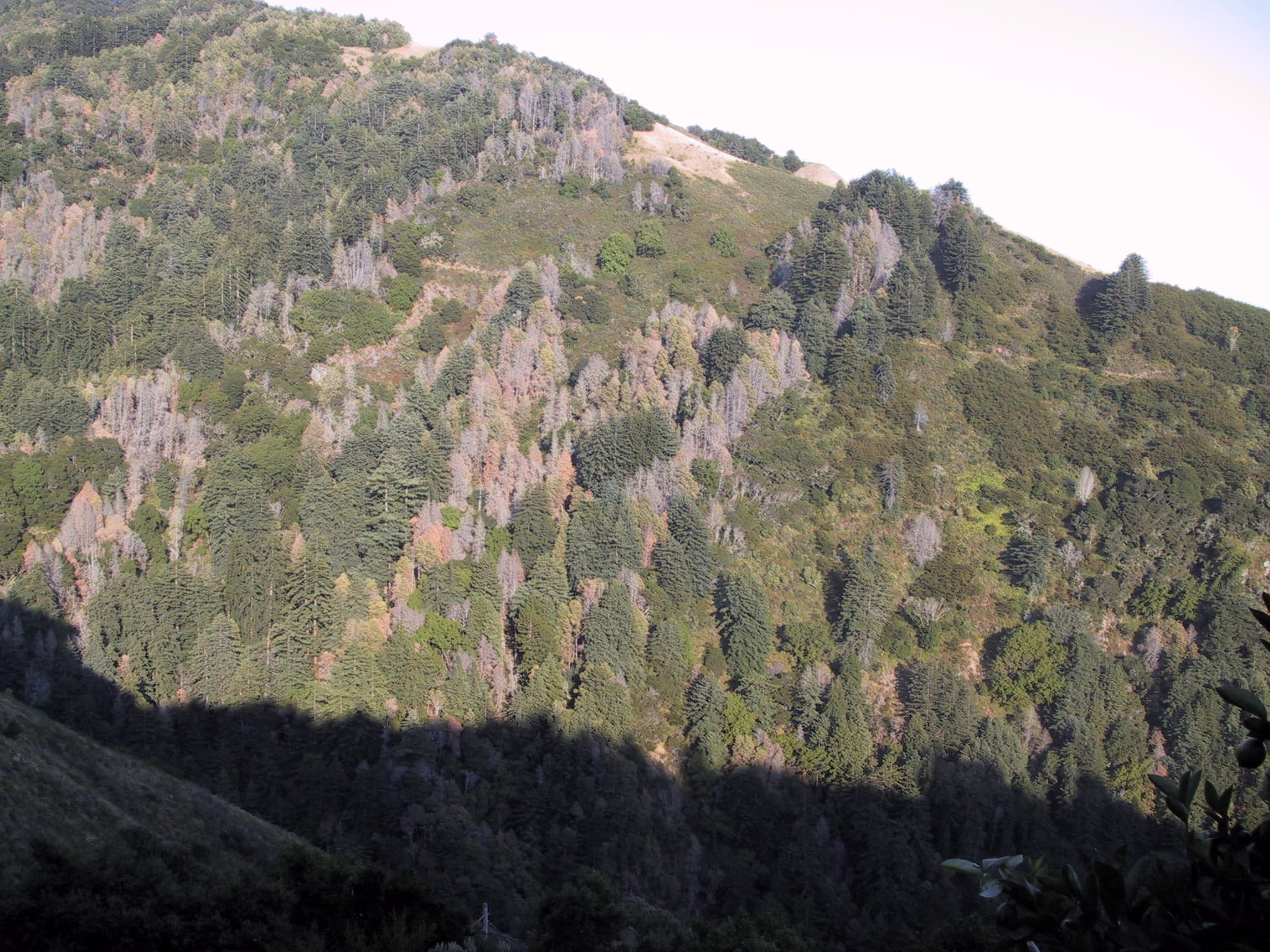
Big Sur hillside with mass oak mortality from Sudden Oak Death — millions of oaks have died along the California coast
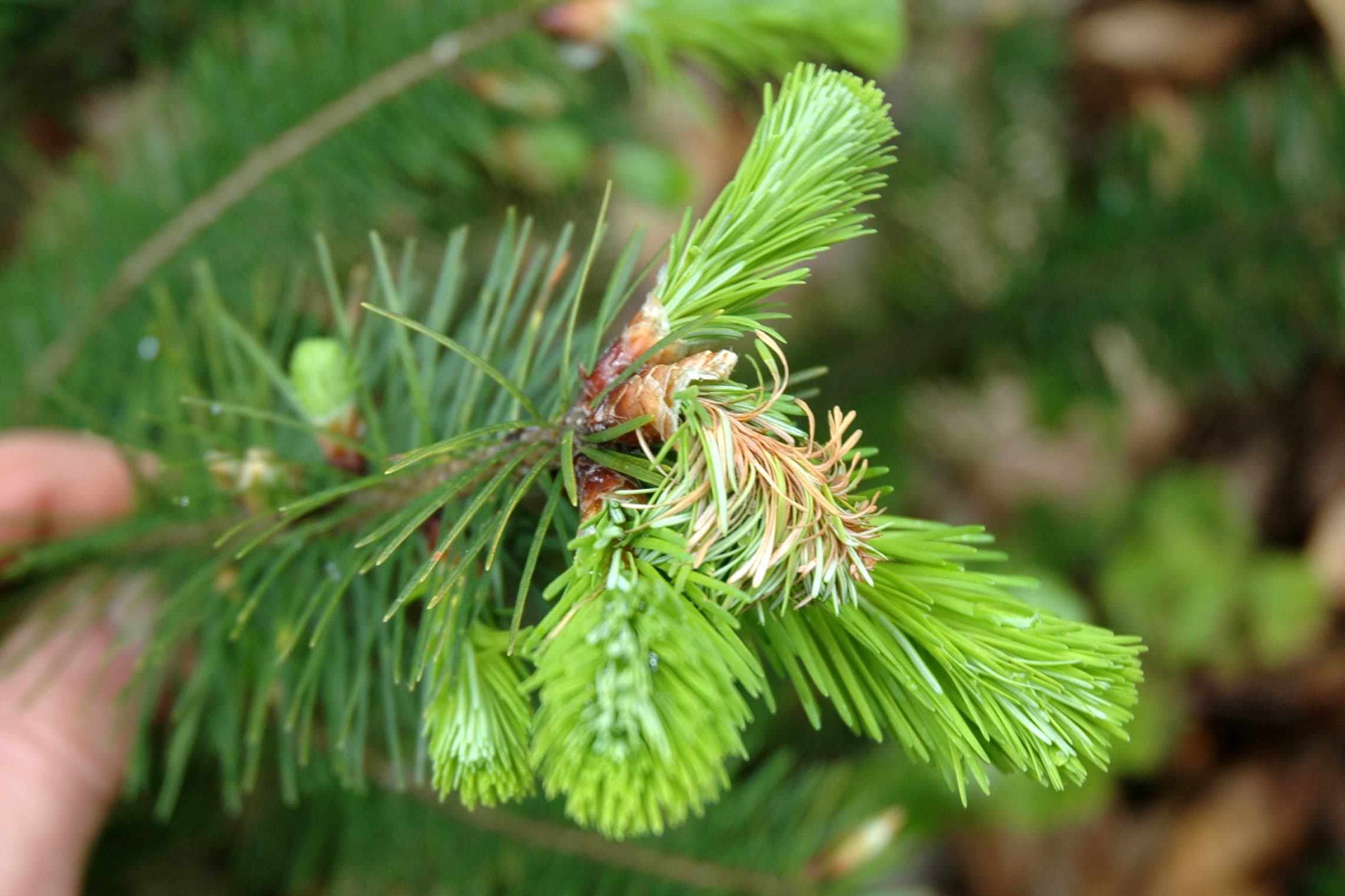
Shoot and twig blight: brown, dead new growth — a key symptom on susceptible conifers and ornamentals
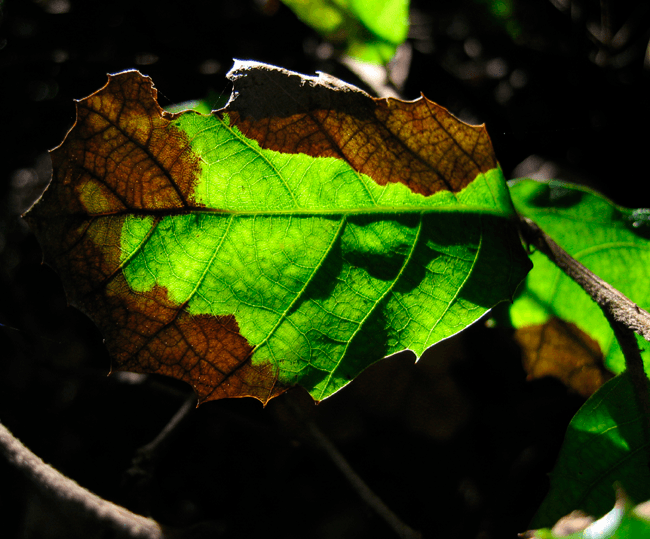
Leaf lesions at a UK monitoring site — ornamental hosts show leaf blight without dying, but produce large quantities of infectious spores
Photo credits: Hemhem20X6 / Wikimedia Commons / Public Domain | Oregon State University / Wikimedia Commons / CC BY-SA 2.0 | DEFRA / Wikimedia Commons / CC BY 2.5
Host Trees
Red Oak, Black Oak, California Black Oak, Tanoak, Rhododendron, Mountain Laurel, Camellia, Viburnum, Pieris
How to Identify It
- Bleeding cankers on the lower trunk and root collar — dark, water-soaked lesions that ooze reddish-brown to black sap that stains the bark
- Leaf blight: purple-brown lesions with irregular margins on leaves and petioles; often starts at leaf tips or margins
- Shoot and twig dieback beginning at new growth tips — dead foliage remains attached initially
- Trunk cambium beneath the bleeding zone is dark reddish-brown when bark is cut away
- On ornamental hosts (rhododendron, camellia, pieris): brown lesions on leaves without trunk symptoms — these plants are "sporulating hosts" that produce infectious spores
Sudden Oak Death is caused by Phytophthora ramorum, a water mold (oomycete) first confirmed in 1995 in California. It has killed millions of oaks and tanoaks along the California and Oregon coast and is one of the most destructive introduced plant pathogens in U.S. history. P. ramorum causes two distinct disease syndromes: in red oaks and black oaks, it forms rapidly lethal bleeding stem cankers that girdle the tree and cause death within months to a few years; in rhododendrons, camellias, viburnums, and other ornamental plants, it causes leaf and twig blight without killing the plant — but those infected leaves produce enormous quantities of spores that spread the pathogen. Red oaks are among the most susceptible species and are abundant throughout Georgia, making introduction here a significant concern. P. ramorum has been intercepted at nurseries across the eastern United States multiple times.
Life Cycle
P. ramorum thrives in cool, wet conditions (50–77°F optimum). It produces two types of spores: sporangia that form on infected leaves and are spread by rain splash, wind-driven mist, and movement of infected plant material; and long-lived chlamydospores that survive in soil and on debris for years. Infection typically begins in the canopy or at wounds; on oaks, the pathogen moves into the bark and kills the cambium in an expanding zone. Spread within a landscape is primarily through rainwater runoff carrying spores from infected ornamental hosts to susceptible oaks. Long-distance spread is almost entirely driven by movement of infected nursery stock — rhododendrons, camellias, and viburnums transported while showing no obvious symptoms but carrying the pathogen.
What Happens If Ignored
Once P. ramorum has established a bleeding canker on a red oak or black oak, no treatment can save the tree — the outcome is fatal. Entire woodlots of red and black oaks can be killed in sequence as spores wash from infected ornamentals onto nearby oaks. In California, millions of oaks died in the span of a decade. Because common Georgia landscape plants (rhododendron, camellia, pieris) serve as reservoir hosts that generate infectious spores without showing serious disease, an introduction could persist and spread silently through the nursery trade long before oak mortality becomes visible.
Recommended Action
Sudden Oak Death is not currently confirmed in Georgia but has been intercepted in nursery inspections across the Southeast. If you notice dark, weeping cankers on the lower trunk of red or black oaks — especially with reddish-brown staining under the bark — do not prune or disturb the tree. Photograph the symptoms and report immediately to the Georgia Department of Agriculture. Avoid purchasing rhododendrons, camellias, or viburnums from states with confirmed P. ramorum outbreaks without certification. Do not move soil, mulch, or plant material from symptomatic areas.
ASIAN LONGHORNED BEETLE
Anoplophora glabripennis
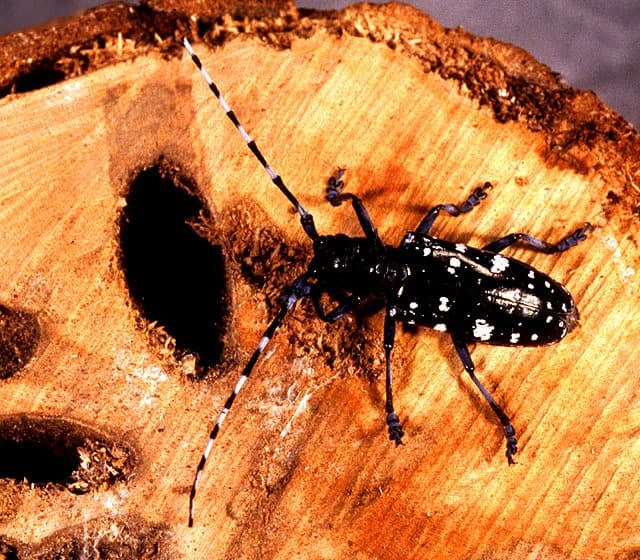
Adult beetle — 1–1½ inches long; white spots and banded antennae are diagnostic
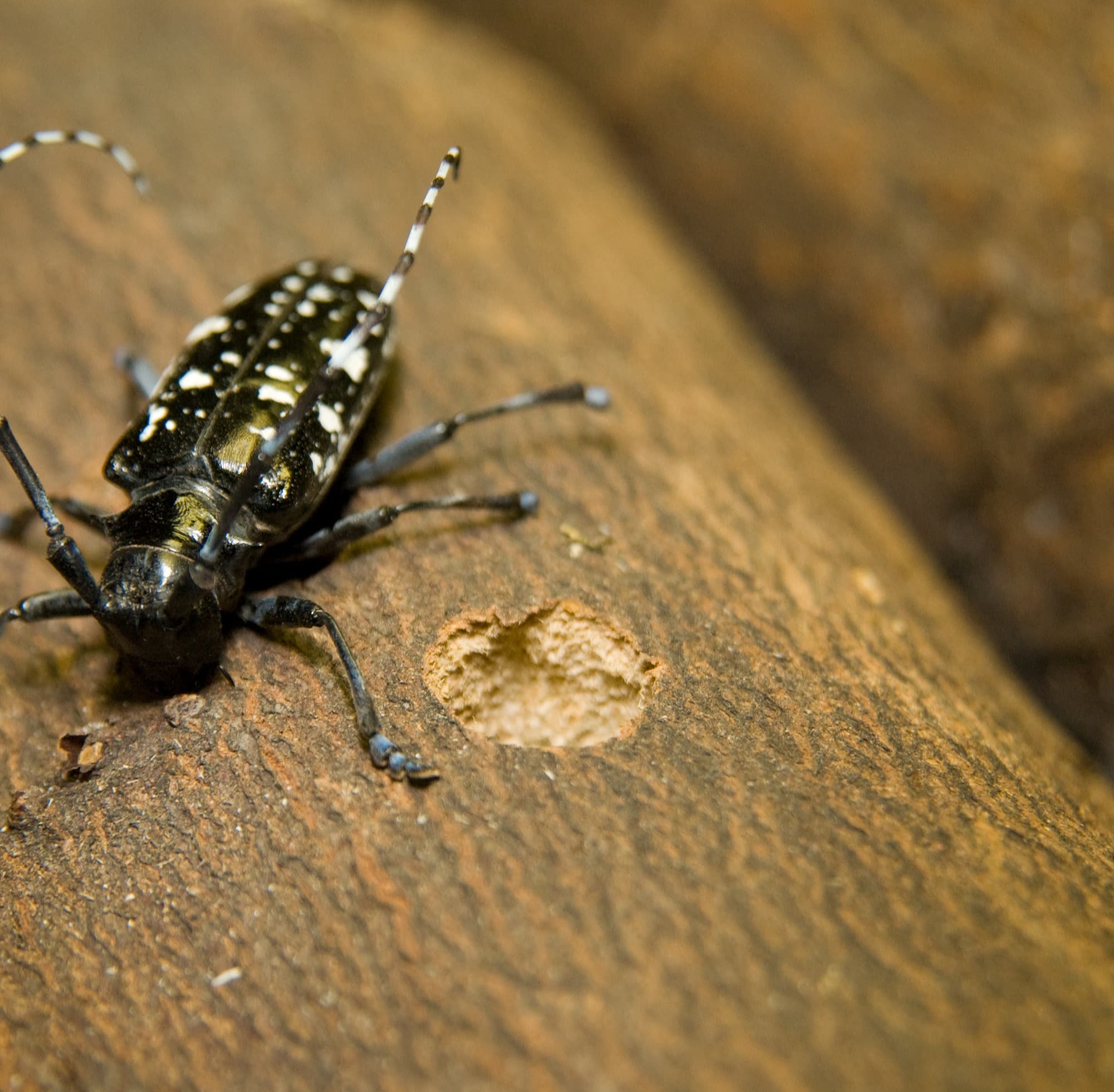
Adult beetle beside its perfectly round ⅜-inch exit hole — a key diagnostic sign
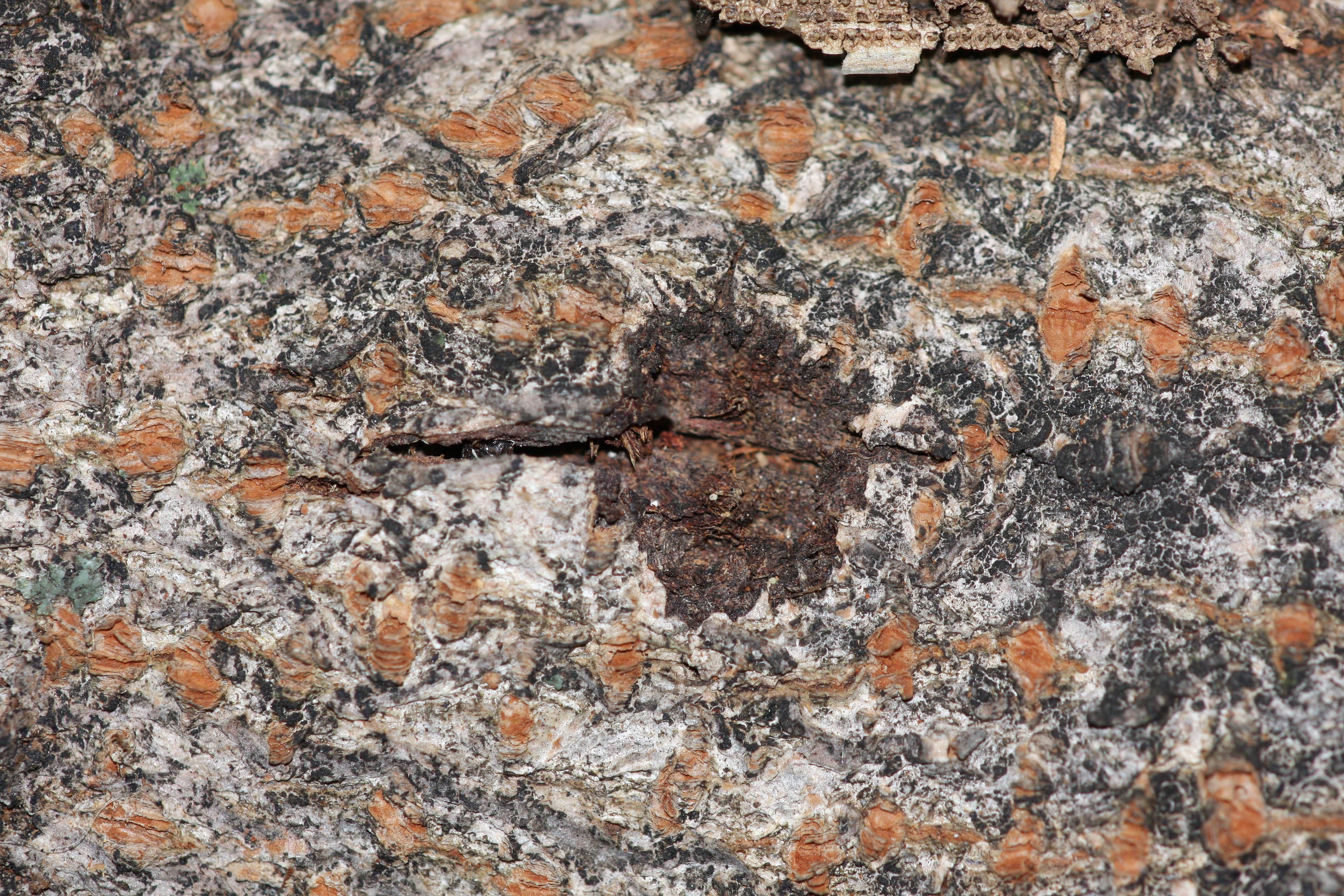
Oviposition pit on maple branch — crescent-shaped bark wound where female deposited an egg
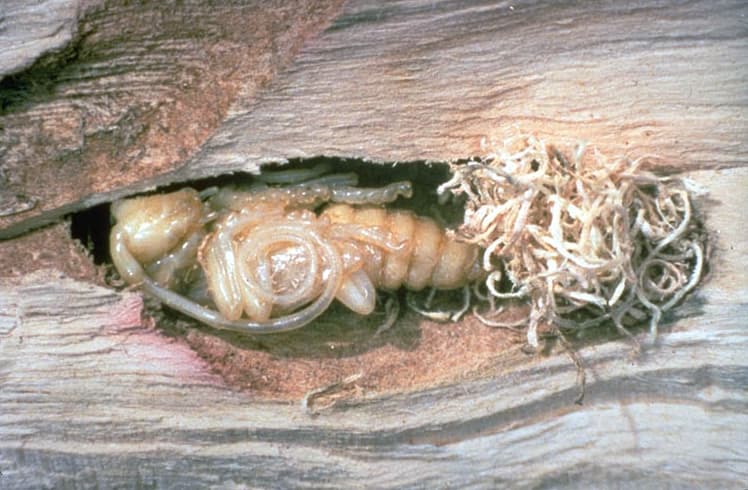
Pupa inside log with frass from larval galleries — larvae tunnel deep into sapwood and heartwood
Photo credits: USDA APHIS / Wikimedia Commons / Public Domain | R. Anson Eaglin, USDA-APHIS / Wikimedia Commons / Public Domain | Yerpo / Wikimedia Commons / CC BY-SA 3.0 | USDA APHIS PPQ / Wikimedia Commons / Public Domain
Host Trees
Silver Maple, Red Maple, Sugar Maple, River Birch, American Elm, Willow, Sycamore, Poplar, Horsechestnut, Buckeye, Ash, London Plane
How to Identify It
- Shiny jet-black beetle, 1–1½ inches long, with approximately 20 white spots on the wing covers (elytra)
- Extremely long antennae — as long as or longer than the body — with distinctive black-and-white banding
- Perfectly round exit holes approximately ⅜ inch (10 mm) in diameter bored through bark — larger and more circular than native beetle holes
- Frass (sawdust-like excrement mixed with wood shavings) accumulating at the tree base or in branch crotches
- Oviposition pits: small, oval bark wounds chewed by females for egg-laying — look like shallow crescent scars on the trunk or branches
- Weeping sap or dark staining around entry and exit wounds
- Canopy dieback in the upper crown, dying branches, or unusually early leaf drop
ALB attacks and kills otherwise healthy, vigorous hardwood trees — unlike most native bark beetles that target stressed trees. Larvae tunnel through sapwood and heartwood, creating large winding galleries that disrupt water and nutrient transport and structurally weaken the tree. There is no treatment once a tree is infested; infested trees must be destroyed. ALB threatens hundreds of millions of North American hardwood trees — urban street trees, commercial timber, and the maple syrup industry are all at risk. In Marietta neighborhoods where silver maple and red maple are among the most common residential shade trees, a single ALB introduction could trigger a mandatory removal program affecting entire streets.
Life Cycle
One generation per year. Adults emerge June–October, chewing perfectly circular exit holes. They feed on bark and twigs for 2–3 weeks before mating. Females chew oviposition pits and deposit 35–90 eggs. Larvae bore first into the phloem, then deep into the sapwood and heartwood, where they overwinter. Pupation occurs in a chamber near the wood surface the following spring. The larval stage lasts 1–2 years depending on temperature. Long-distance spread is almost entirely caused by human movement of infested wood — firewood, nursery stock, and wooden packing materials.
What Happens If Ignored
ALB kills every infested tree with certainty; no chemical treatment can save an infected tree. Because it spreads through root grafts and short-range adult flight, a single introduction into a Marietta neighborhood could trigger a USDA-mandated survey and removal program affecting all host trees within a ½-mile radius — including healthy, uninfested trees in the regulated zone. Property owners in ALB quarantine zones in New York and New Jersey have lost dozens of mature maple and willow trees to mandatory removal. Early reporting is the only effective response.
Recommended Action
ALB is not established in Georgia, but early detection is critical. Learn the signs: perfectly round ⅜-inch exit holes, white-spotted black beetles with banded antennae, oviposition pit scars on bark, and frass accumulation at the base. If you observe these signs — especially on maple, birch, elm, or willow — do NOT prune or disturb the tree. Photograph the beetle or damage and report immediately to the Georgia Department of Agriculture. Do not move firewood, logs, or nursery stock from any state where ALB is confirmed (NY, MA, OH, IL, NJ, SC).
EMERALD ASH BORER
Agrilus planipennis
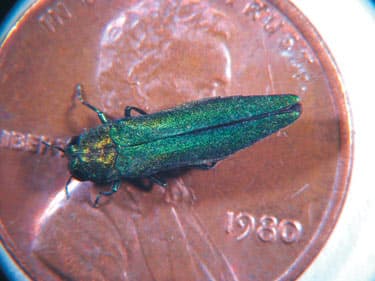
Adult beetle — metallic emerald-green, ½ inch long
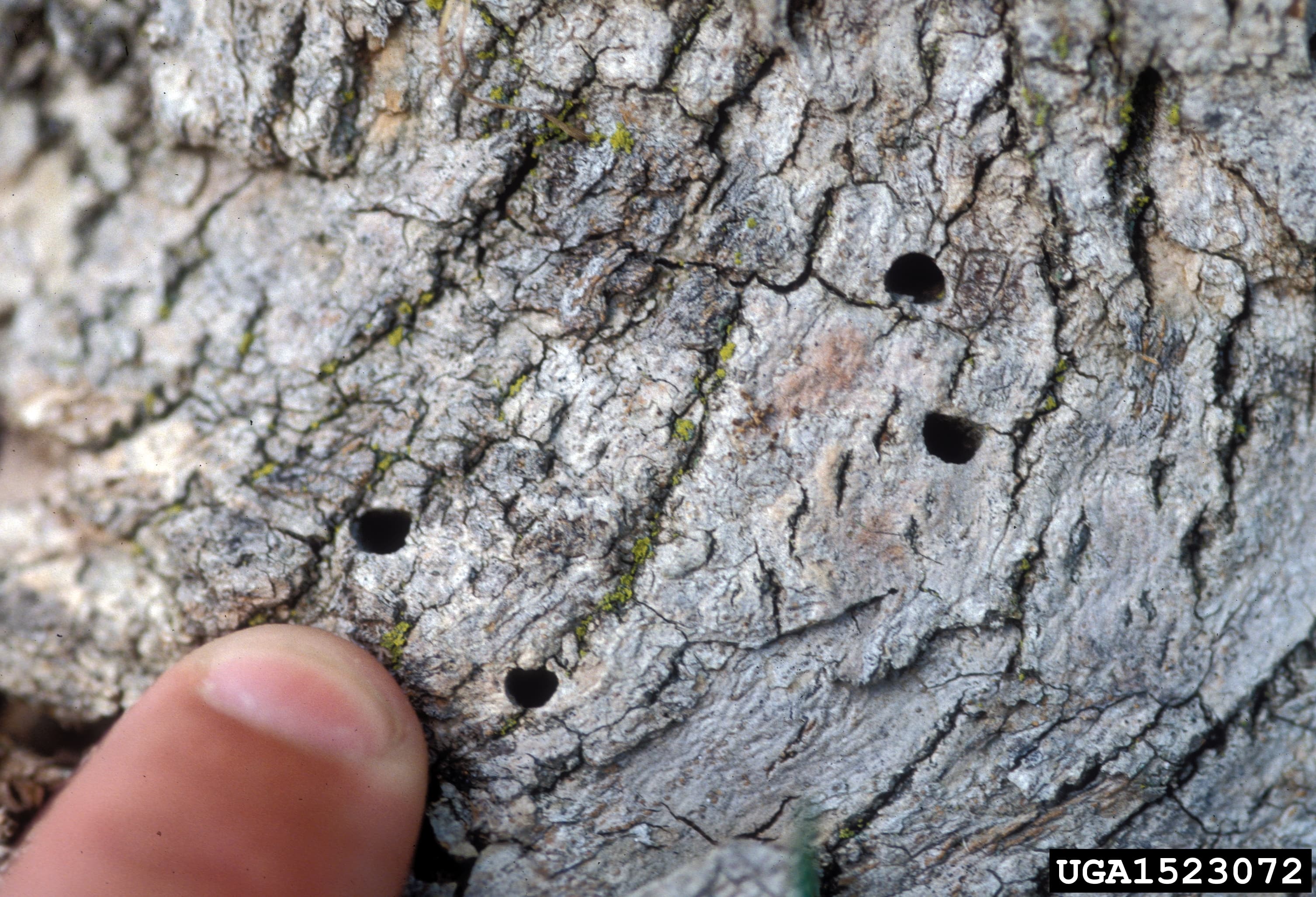
D-shaped exit hole (~⅛ inch) — diagnostic; native borers leave round holes
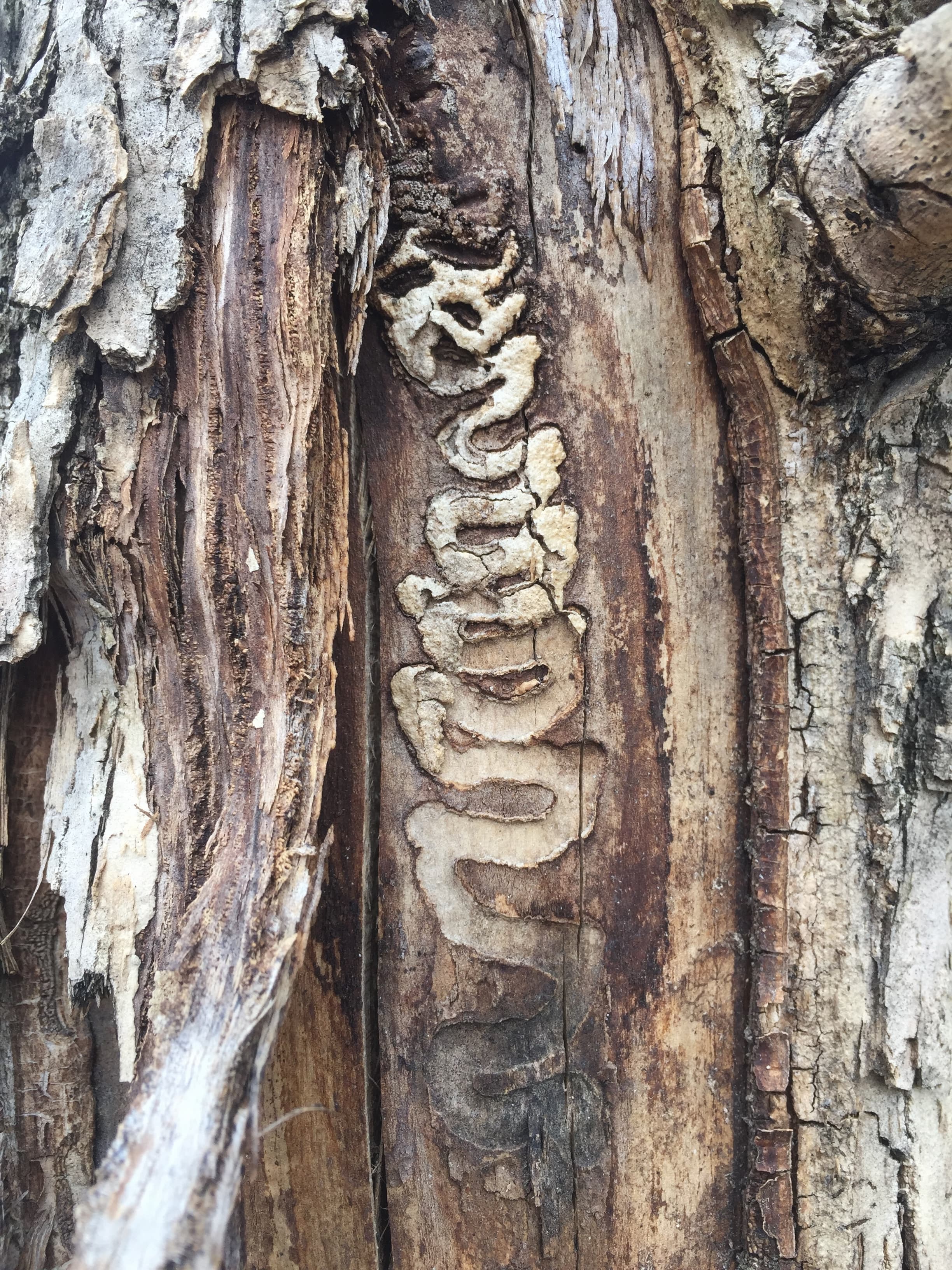
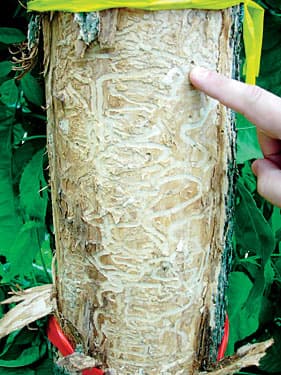
Serpentine galleries under bark — larvae girdle the phloem, killing the tree
Crown dieback progressing top-down — tree typically dies within 2–5 years
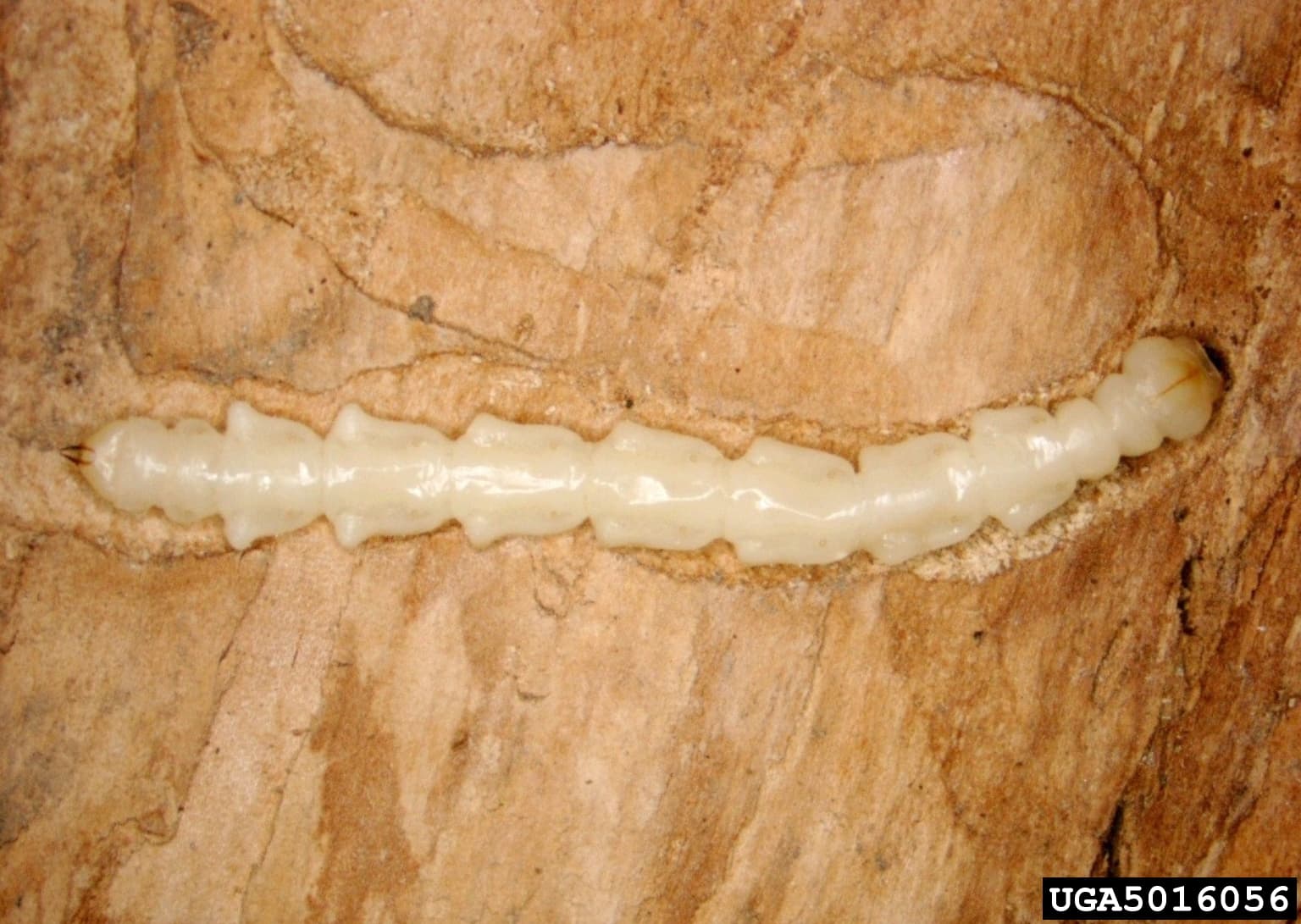
Cream-colored, bell-segment larva — feeds in the phloem/cambium layer
Photo credits: USDA Forest Service / Wikimedia Commons / Public Domain | Daniel Herms, The Ohio State University, Bugwood.org / Wikimedia Commons / CC BY 3.0 | judygva / Wikimedia Commons / CC BY 2.0 | USDA Forest Service / Wikimedia Commons / Public Domain | Pennsylvania DCNR / Wikimedia Commons / CC BY 3.0
Host Trees
White Ash, Green Ash, Black Ash, Blue Ash, Pumpkin Ash
How to Identify It
- Adult: brilliant metallic emerald-green beetle, ½ inch (12–14 mm) long, with a flat-topped abdomen; red or purple upper abdomen visible when wings are spread
- D-shaped (not round) exit holes approximately ⅛ inch (3–4 mm) wide — the single most diagnostic sign; distinguishes EAB from native bark beetles which make round holes
- Serpentine (S-shaped) larval galleries packed with frass immediately beneath the bark, cutting off the tree's nutrient supply
- Crown dieback beginning at the top of the canopy and progressing downward — individual branch "flagging" (brown leaves on otherwise green tree)
- Vertical bark splits and fissures on the trunk as larval galleries fill with callus tissue
- Epicormic sprouting (dense clusters of water sprouts) at the base of the trunk or along major limbs — a stress response signaling canopy loss
- Woodpecker feeding damage ("blonding"): patches of bark stripped away, leaving pale wood — woodpeckers excavate to reach larvae beneath
EAB kills ash trees by girdling the phloem and cambium layers with dense larval galleries, completely blocking water and nutrient transport from roots to crown. Trees typically die within 2–5 years of infestation. Since first detected in Michigan in 2002, EAB has killed hundreds of millions of ash trees across North America — the largest loss of a single tree genus in recorded North American history. All native North American ash species (Fraxinus) are susceptible; no natural resistance exists.
Life Cycle
One generation per year in Georgia. Adults emerge May–June, chewing distinctive D-shaped exit holes. Females lay eggs singly in bark crevices; eggs hatch in 1–2 weeks. Larvae bore through the outer bark into the phloem and cambium, feeding in serpentine galleries through summer and fall. Larvae overwinter as prepupae in chambers in the outer sapwood. Pupation occurs in early spring. Full larval development may span two years in cooler climates, but in Georgia's climate one-year cycles are typical.
What Happens If Ignored
Untreated ash trees die within 2–5 years of EAB infestation — with near certainty. There is no recovery once the larval galleries have girdled the phloem. Dead ash trees become structurally hazardous quickly: the wood becomes brittle within 1–2 years of death, and ash has a documented pattern of sudden, unpredictable branch and stem failure. A large dead ash near a structure or over a lawn represents an extreme and immediate hazard risk.
Recommended Action
EAB is confirmed throughout Georgia; assume all unprotected native ash trees are at risk. Preventive systemic insecticide treatment (emamectin benzoate trunk injection or soil-applied dinotefuran) by a licensed arborist is effective for high-value landscape trees — start before visible crown symptoms. Once the canopy shows more than 30–50% dieback, treatment success rates drop sharply. Infested trees should be removed promptly to reduce local beetle pressure and eliminate the hazard. Report new county sightings to the Georgia Department of Agriculture. Do not move ash firewood, logs, or nursery stock out of the quarantine zone.
SPOTTED LANTERNFLY
Lycorma delicatula
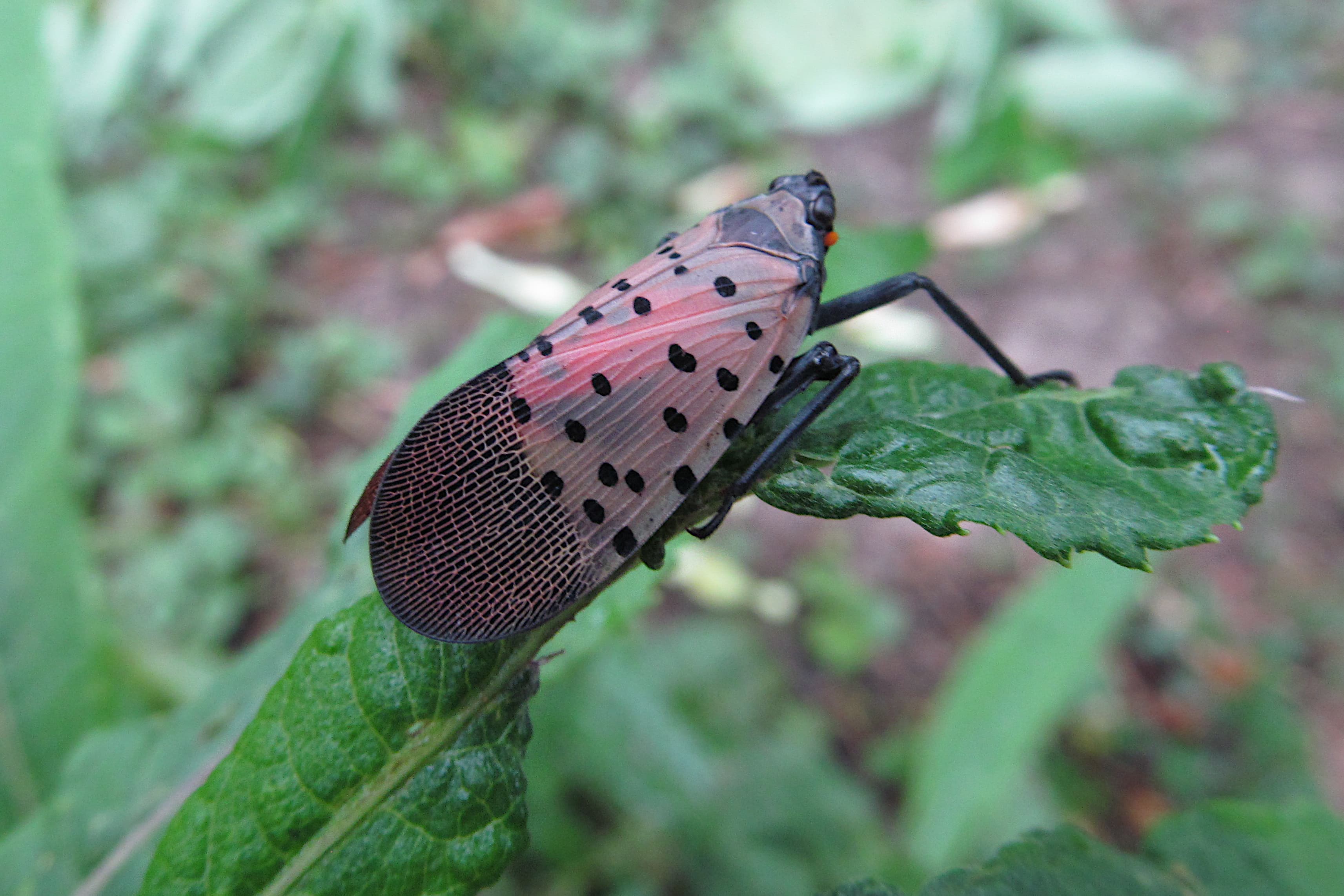
Adult Spotted Lanternfly — forewings are light brown with black spots; brilliant red hind wings visible in flight
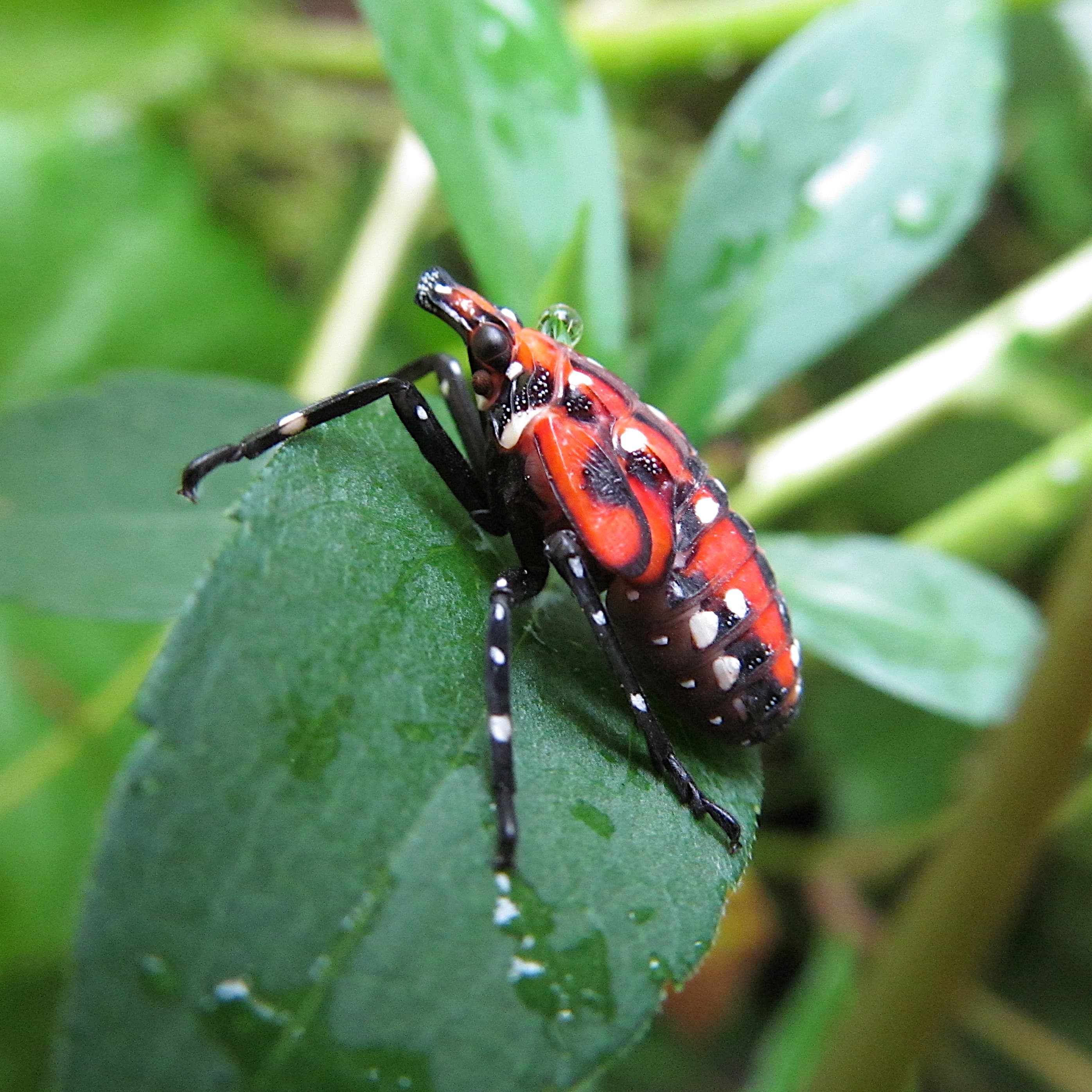
Fourth-instar nymph — the distinctive red stage with black and white markings that precedes adulthood
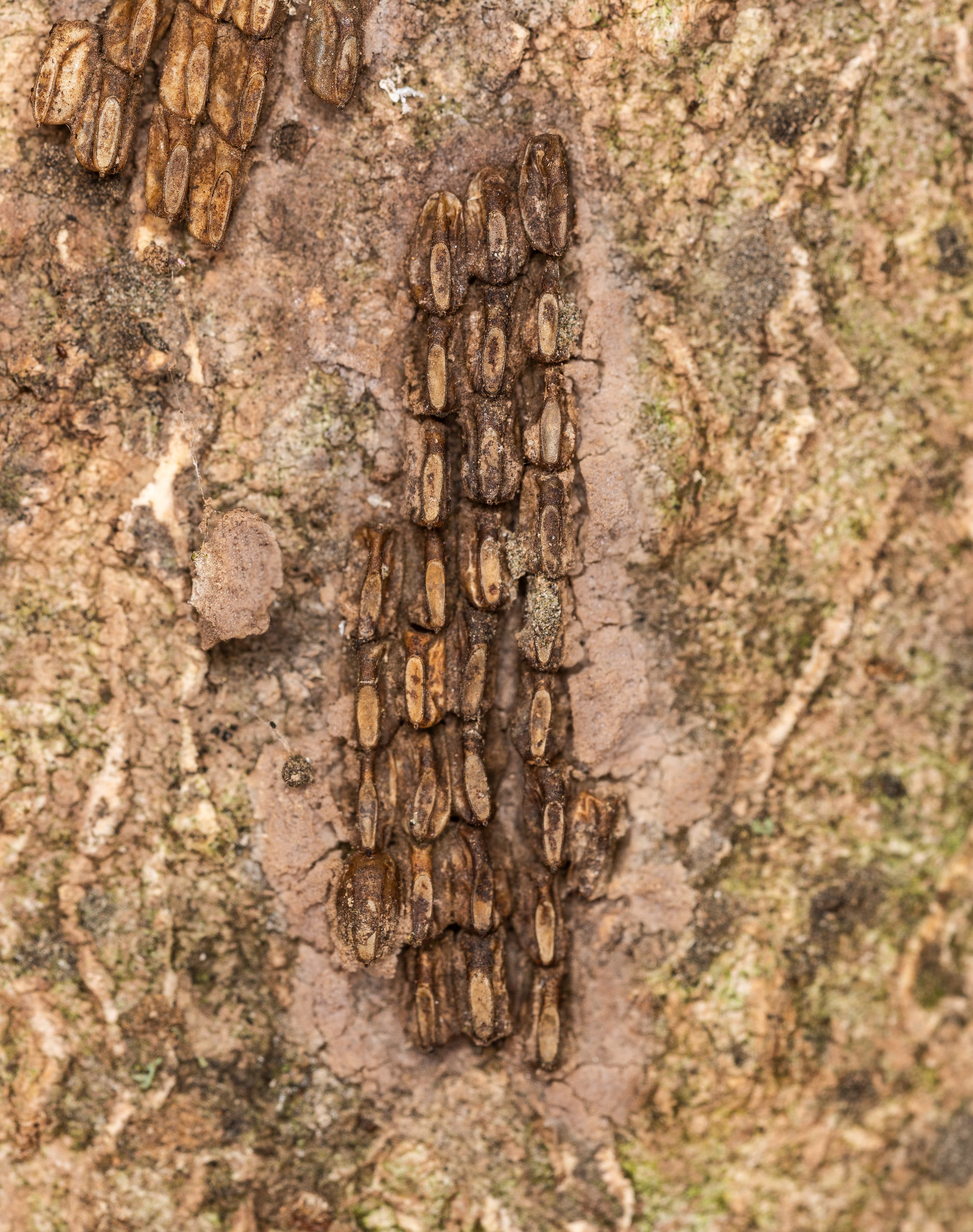
Egg mass on bark — grey waxy putty 1–2 inches long; laid on any flat surface; survives winter outdoors
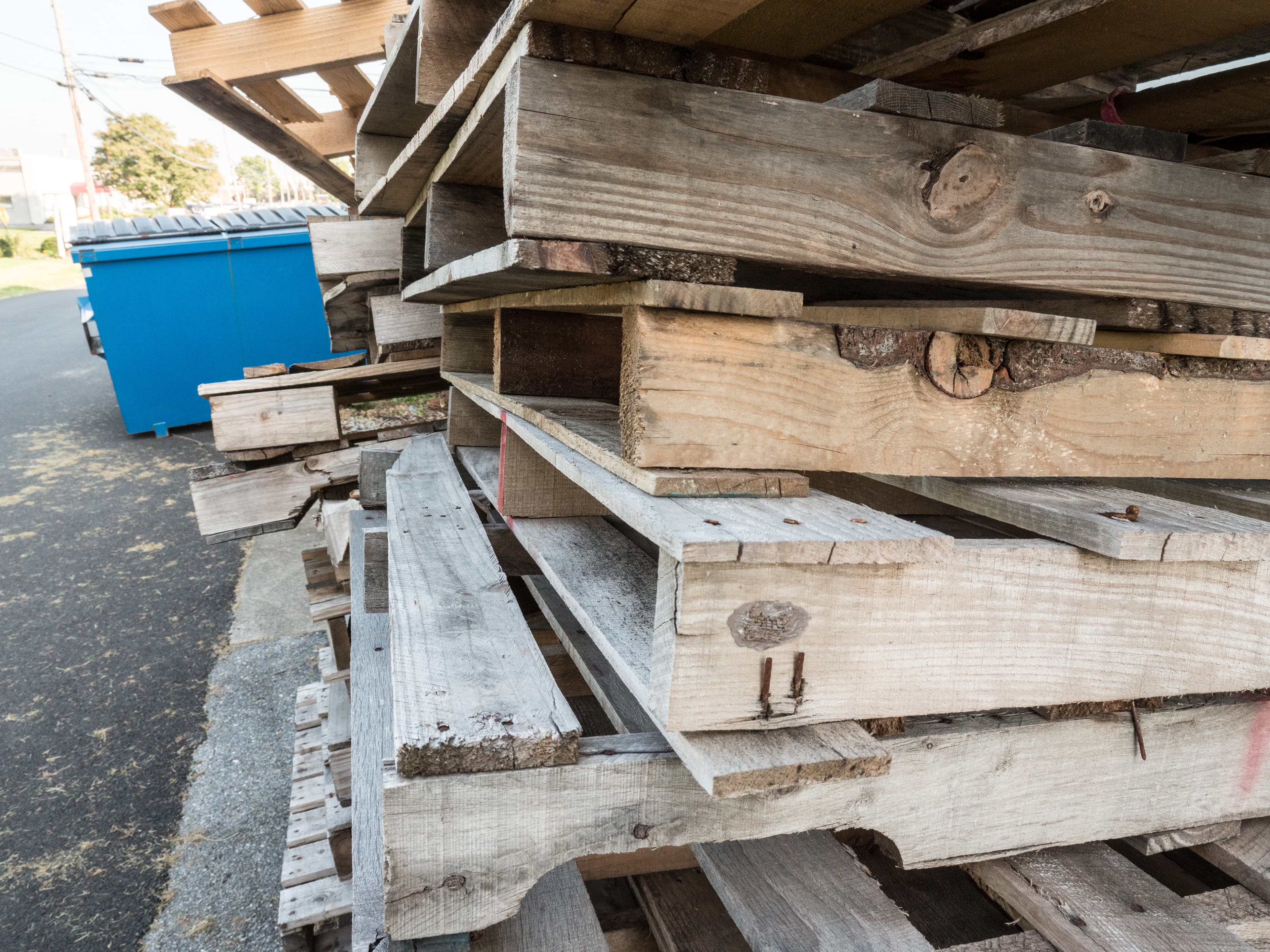
Mass aggregation on pallets and wood — adults and egg masses hitch rides on shipping materials, enabling long-distance spread
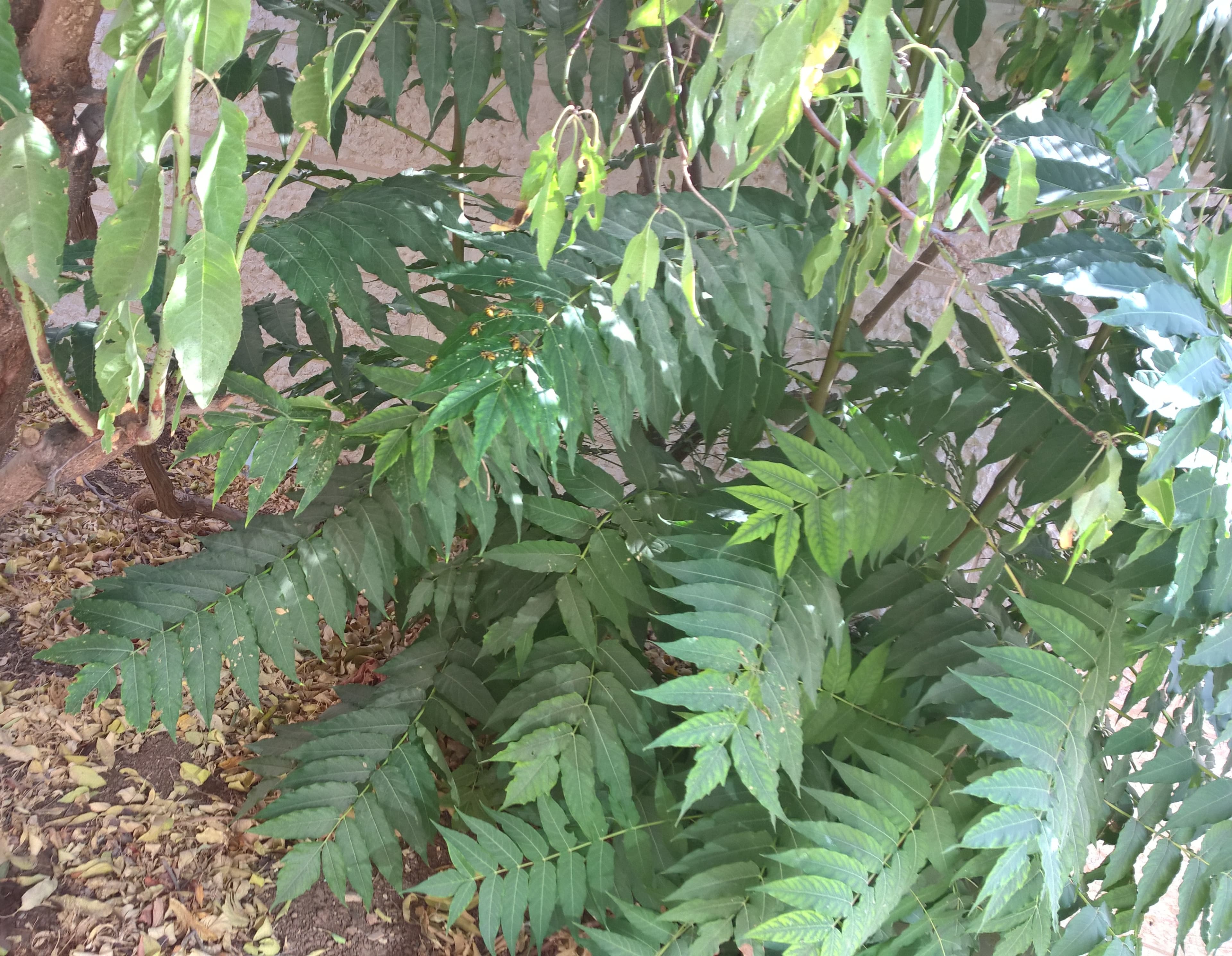
Tree of Heaven (Ailanthus altissima) — the primary host plant already widespread in Georgia; removing it limits SLF breeding sites
Photo credits: Cbaile19 / Wikimedia Commons / CC0 | Cbaile19 / Wikimedia Commons / CC0 | USDA ARS / Stephen Ausmus / Wikimedia Commons / Public Domain | USDA APHIS / Lance Cheung / Wikimedia Commons / Public Domain | Hexafluoride / Wikimedia Commons / CC BY-SA 4.0
Host Trees
Tree of Heaven, Grapevine, Apple, Peach, Plum, Cherry, Hops, Walnut, Oak, Maple, Willow, Birch, Poplar
How to Identify It
- Adults approximately 1 inch long with striking wings: light brown forewings with black spots and a speckled band; scarlet hind wings with black spots and white-and-black bars at the rear — visible when wings are spread in flight or when alarmed
- Early nymphs (instars 1–3) are small and black with white spots on the body and legs; fourth-instar nymphs develop a bright red coloration with black and white markings before becoming adults
- Egg masses appear as grey, mud-like putty smeared in a 1–2 inch elongated patch on flat surfaces — tree bark, wooden pallets, stone, outdoor furniture, vehicles, and almost any hard surface
- Heavy, sticky honeydew deposits on leaves, branches, and surfaces beneath infested trees, often leading to a mat of black sooty mold on leaves and ground cover
- Weeping, fermented sap oozing from the bark surface where the insects feed, attracting wasps, bees, and other insects to the wound
- Large aggregations of nymphs and adults congregating on plant stems and trunks in late summer and fall, particularly on Tree of Heaven (Ailanthus altissima)
Spotted Lanternfly is a piercing-sucking insect that feeds on plant sap from stems, branches, and trunks — not leaves. It does not consume wood or bore tunnels. Instead, mass feeding depletes the plant of nutrients and photosynthate, weakens its overall vigor, and causes significant honeydew buildup. The honeydew coats leaves and promotes a thick mat of black sooty mold that blocks sunlight and further reduces photosynthesis. Repeated heavy infestations can kill young plants and vines outright and leave mature trees severely weakened and susceptible to secondary pathogens. SLF poses the most serious risk to commercial viticulture (grapes), hop yards, apple and peach orchards, and walnut operations — USDA has estimated it could cost Pennsylvania agriculture $324 million annually if uncontrolled. Tree of Heaven (Ailanthus altissima), an already widespread invasive across Georgia, is the insect's preferred host and acts as a population reservoir that fuels spread into orchards and residential landscapes.
Life Cycle
One generation per year. Egg masses are laid in fall (September–November) on flat hard surfaces — tree bark, stone walls, vehicles, and shipping materials — and overwinter outdoors, surviving temperatures well below freezing. Eggs hatch in late April–May, releasing tiny black first-instar nymphs. Nymphs pass through three more instars (still black-with-white-dots), then transition to the red fourth-instar stage in July–August before adults emerge in late July–September. Adults mate and females lay one or two egg masses containing 30–50 eggs each, sealed with a grey waxy coating. Adults die with the first hard frost, but egg masses survive the winter on virtually any outdoor surface — vehicle undercarriages, packing crates, nursery stock, and firewood are the primary long-distance dispersal routes. Georgia's relatively mild winters offer suitable overwintering conditions for egg masses across most of the state.
What Happens If Ignored
Established SLF populations devastate commercial fruit, grape, and hop operations within a few seasons. Residential trees — particularly ornamental maples, willows, and fruit trees — suffer chronic sap loss that reduces growth and fruit production and, in heavy infestations, can kill young specimens. Because the insect builds enormous aggregations and produces vast quantities of honeydew, untreated infestations make outdoor spaces unusable in late summer. Tree of Heaven, already common in disturbed areas throughout Georgia, will sustain SLF populations regardless of control efforts on other hosts, making early suppression and Tree of Heaven management the only effective long-term strategy.
Recommended Action
SLF has been confirmed in several southeastern states adjacent to Georgia and is actively expanding. USDA APHIS urges everyone to inspect vehicles, equipment, and outdoor goods — especially when traveling from confirmed infestation states — and to scrape off any egg masses into rubbing alcohol. In Georgia, report any suspected SLF sighting immediately to the Georgia Department of Agriculture using their online pest report portal. If confirmed on your property: contact a licensed arborist or pest management professional for treatment options (systemic insecticides and contact insecticides are effective); remove or girdle Tree of Heaven on your property to eliminate the primary breeding reservoir; and do not move nursery stock, untreated firewood, or outdoor furniture from infested areas. Early detection and immediate reporting are the most effective tools Georgia has to delay or prevent establishment.
Why Reporting Matters
Many of these pests are subject to USDA APHIS federal quarantine programs. Early reporting to the Georgia Department of Agriculture or the Georgia Forestry Commission can trigger rapid response that slows spread and protects neighboring properties. When in doubt, photograph the insect or symptoms and report it.
SEE ANY OF THESE ON YOUR PROPERTY?
DON'T WAIT.
Early intervention is almost always faster and cheaper than emergency removal. Our certified arborists provide free on-site assessments across Cobb County.
STRUCTURAL HAZARDS
These physical defects affect a tree's ability to stay standing under wind, ice, or its own weight. Many can be spotted from the ground with a trained eye — and some require immediate action.
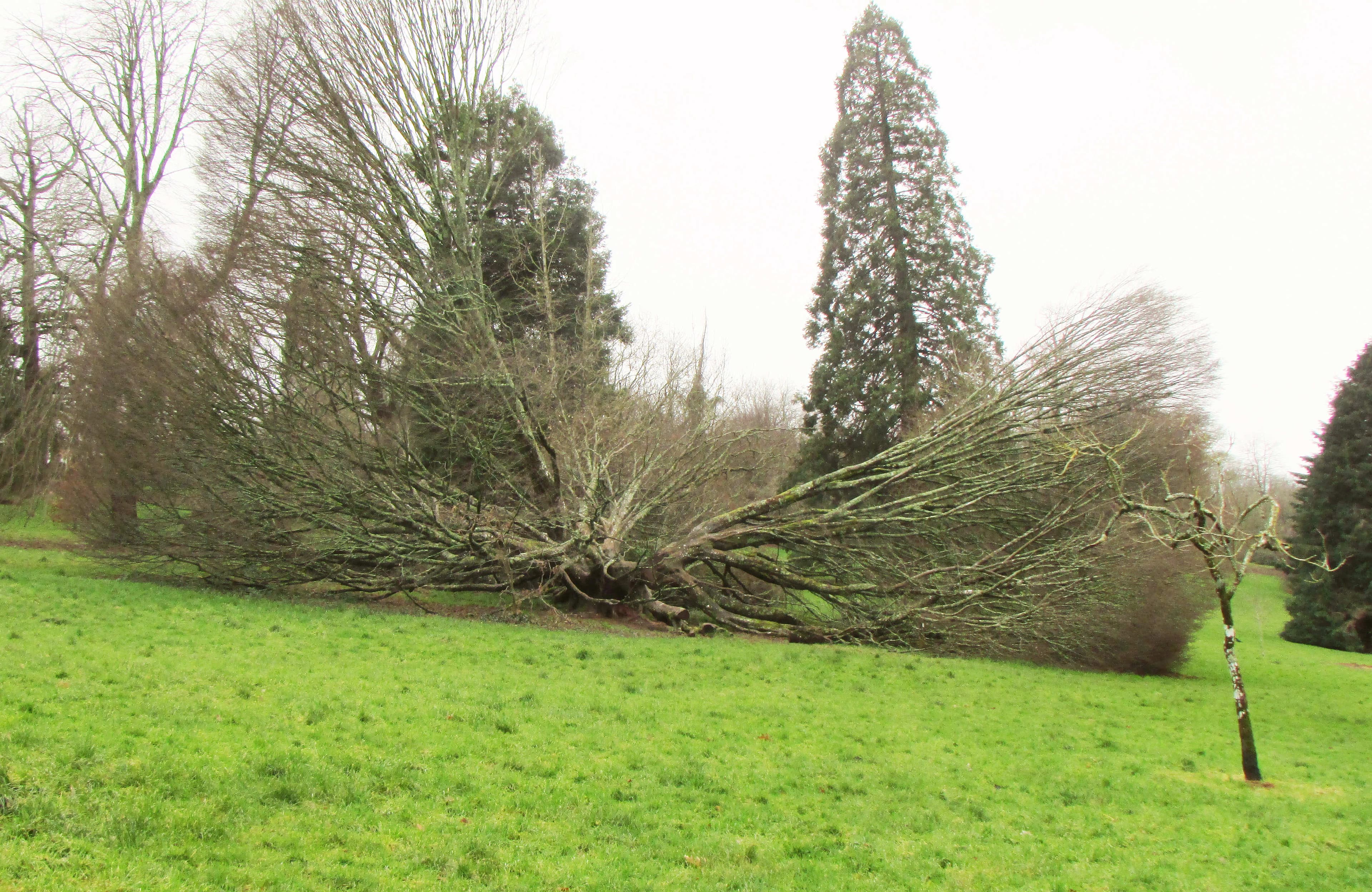
USDA Forest Service / Wikimedia Commons / Public Domain
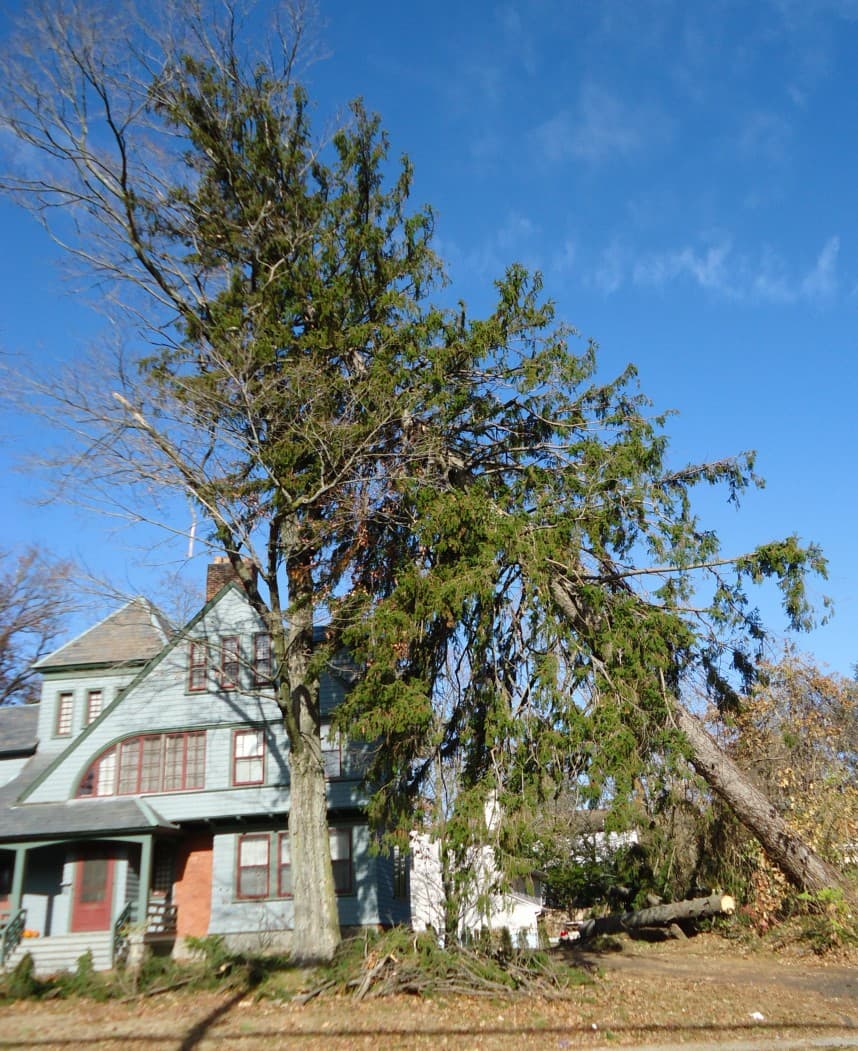
CO-DOMINANT STEMS WITH INCLUDED BARK
What It Looks Like
- Two major stems of similar size rising from a tight V-crotch
- Dark seam of inward-growing bark visible at the union
- Visible crack or bark separation at the crotch under canopy weight
Two competing leaders grow upward at a narrow angle; bark grows inward between them instead of forming a strong wood-to-wood bond; extremely common in oaks, maples, and Bradford pears
What Happens If Ignored
The included bark union acts like a pre-loaded crack. One of the stems will eventually split away — often taking a section of the trunk with it. Wind, ice, or heavy rain can trigger sudden failure.
Recommended Action
Structural pruning when young prevents this failure mode entirely. Mature trees with co-dominant stems over structures need cable bracing or removal of one stem by a certified arborist.
USDA Forest Service / Wikimedia Commons / Public Domain
LEAN WITH ROOT PLATE HEAVE
What It Looks Like
- Tree leaning noticeably (more than 10–15 degrees off vertical)
- Soil mounding, cracking, or lifting on the side opposite the lean
- Exposed roots on the tension side of the lean
Root plate failure on the compression side; roots have broken, rotted, or been undercut by construction, erosion, or saturated soil
What Happens If Ignored
Root plate failure is progressive and sudden. Trees with active heave can fall without any additional wind event — the root plate is already in motion.
Recommended Action
Do not wait. This is an emergency removal situation. Keep people and vehicles out of the fall zone until an arborist can assess.
Steven J. / Wikimedia Commons / CC BY-SA 4.0
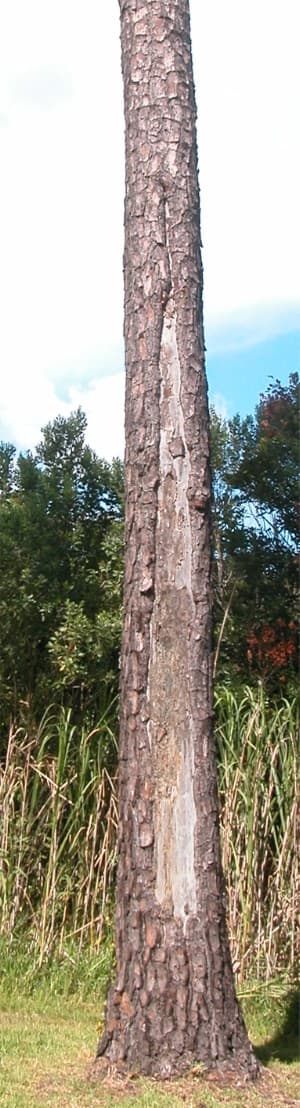
CRACKS AND SPLITS IN MAIN TRUNK
What It Looks Like
- Vertical or horizontal cracks running through the bark and into the wood
- Crack edges that show separation or movement
- Frost cracks or lightning wounds that have not closed over
Wind stress, lightning strike, frost, or long-term structural overload; cracks indicate the wood has fractured and the load-bearing capacity of the trunk is compromised
What Happens If Ignored
Cracks propagate under load. A trunk crack that looks stable today can split completely in the next storm, sending the top half of the tree onto whatever is below.
Recommended Action
Professional assessment immediately. Cabling may stabilize minor cracks; significant trunk splits typically require removal or dramatic crown reduction.
USDA Forest Service / Wikimedia Commons / Public Domain
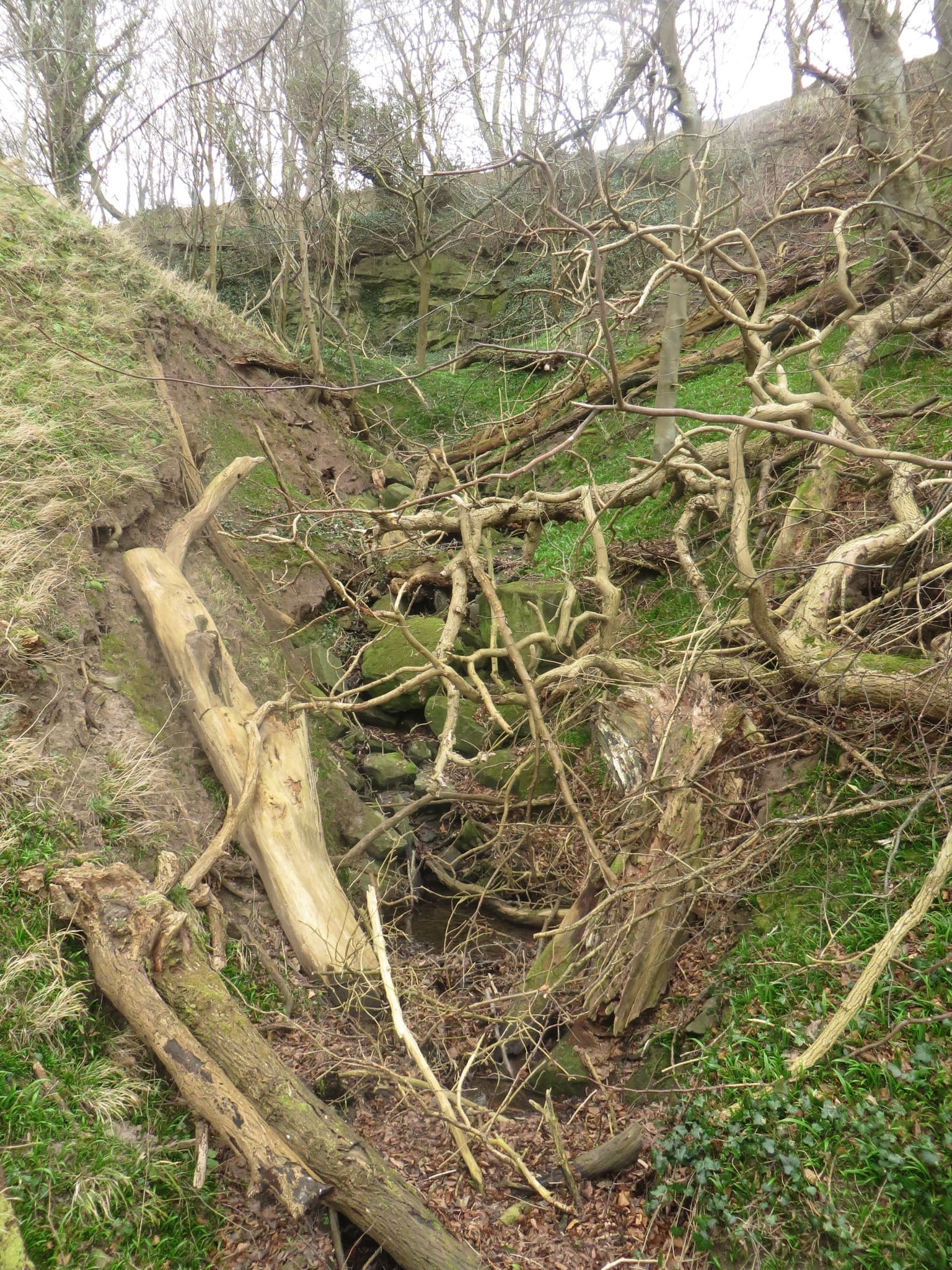
HANGING DEAD BRANCHES ("WIDOW MAKERS")
What It Looks Like
- Dead branches suspended in the canopy, caught on live branches below
- No foliage; bark peeling or already absent
- Branch may be at a steep downward angle after partial break
Dead branches lose bark adhesion and break away at the attachment point; caught in the canopy by surrounding live branches; drop without warning — often hours or days after the initial break
What Happens If Ignored
Hanging branches fall at unpredictable times — not necessarily during storms. A 20-lb branch falling 40 feet develops lethal impact force.
Recommended Action
Immediate removal by a certified arborist. Do not stand under or near the tree until the branch is down. This is not a DIY job — dislodging a hung branch without proper rigging is dangerous.
J. Williams / Wikimedia Commons / CC BY-SA 3.0
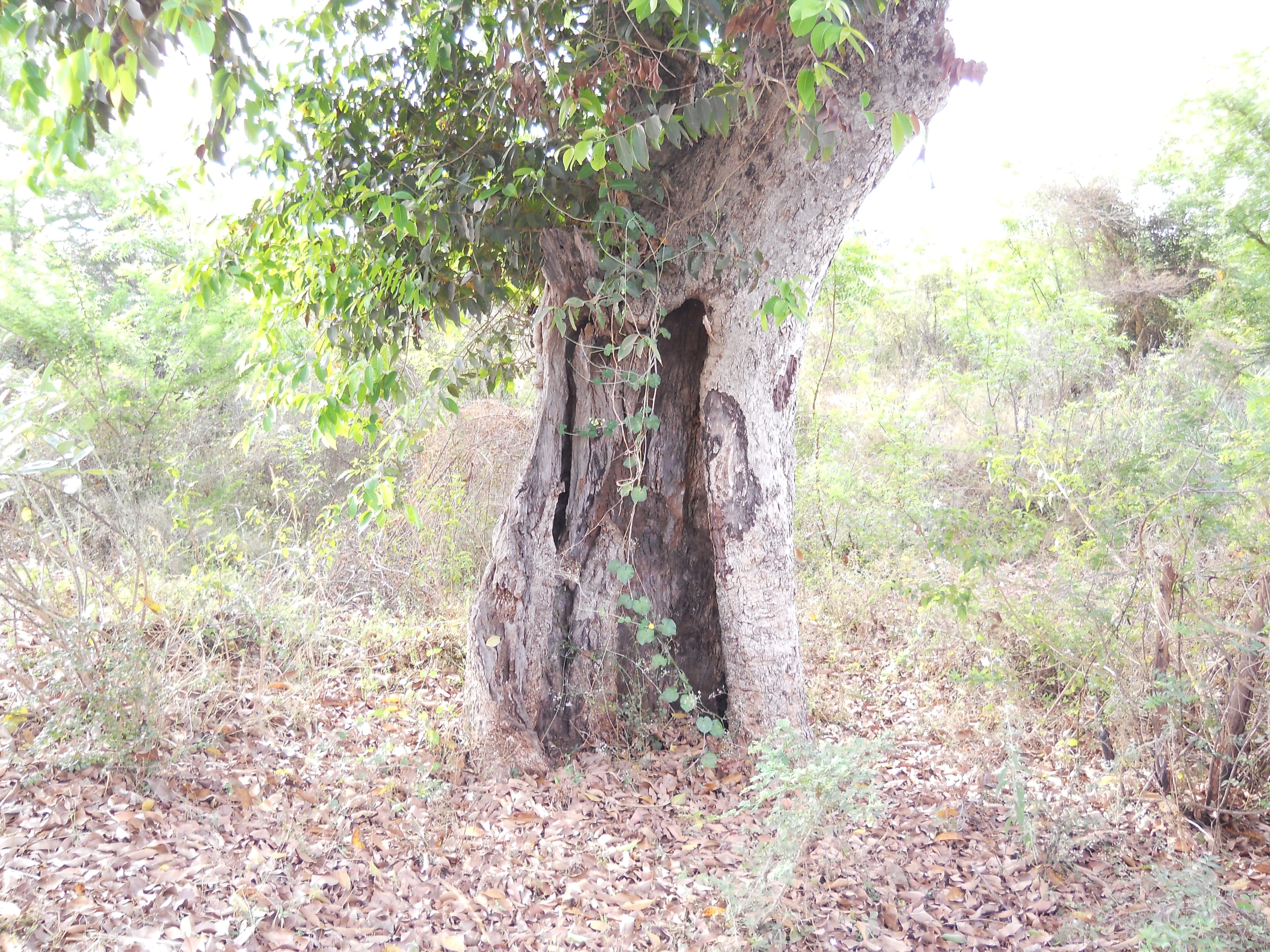
CAVITY OR HOLLOW TRUNK
What It Looks Like
- Visible opening in the trunk — round, oblong, or crack-like
- Soft, spongy wood when probed near the opening
- Hollow sound when trunk is knocked with a mallet
Internal decay following branch removal wounds, lightning, or infection; wood-rotting fungi break down heartwood; remaining shell bears all structural load
What Happens If Ignored
Shell thickness is the only structural element remaining. As decay continues, the shell thins. Engineers use a 1-inch-of-shell-per-inch-of-diameter rule of thumb — below this ratio, failure risk becomes significant.
Recommended Action
Have a certified arborist measure shell thickness and assess decay extent. Small cavities in otherwise sound trees may be manageable; large cavities near the root flare or in major scaffold limbs are serious.
George_K_ / Wikimedia Commons / CC BY-SA 4.0
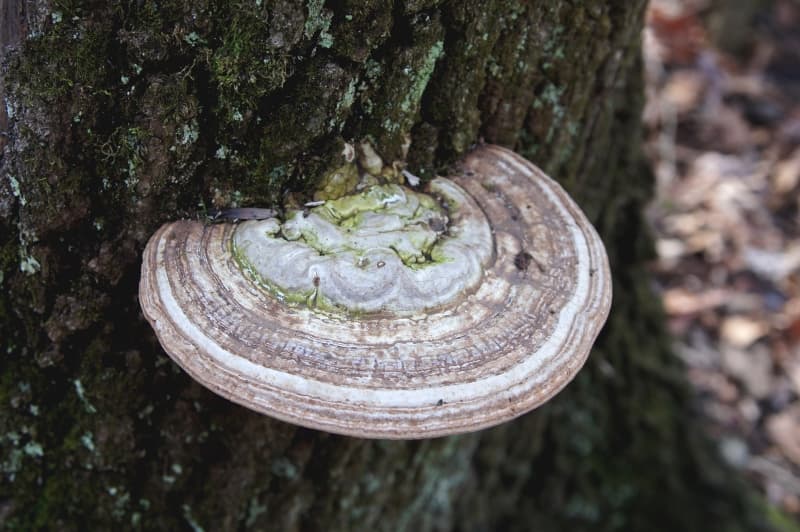
MUSHROOMS OR CONKS ON TRUNK OR ROOTS
What It Looks Like
- Shelf-like bracket fungi (conks) growing from trunk or major roots
- Any mushrooms or fungal growth at the root flare or buttress roots
- Ganoderma conks: kidney-shaped, reddish-brown on top, white pore surface below
Bracket fungi are the fruiting bodies of wood-decay organisms already working inside the tree; the visible mushroom represents extensive internal mycelial colonization
What Happens If Ignored
By the time conks appear, significant structural wood has already been consumed. Ganoderma species attack root and butt wood — the anchor system. Trees infected with Ganoderma have no effective treatment and should be assessed for removal.
Recommended Action
Do not remove the conks (they are a symptom, not the disease). Have a certified arborist identify the fungal species and assess the extent of internal decay.
LIGHTNING STRIKE SCARRING
What It Looks Like
- Long vertical scar running down the trunk, often spiraling with the grain
- Bark blown off or shredded in a narrow strip from crown to base
- Sudden wilting or browning of one side or all of the crown shortly after a storm
Direct lightning strike vaporizes moisture in the sapwood, blowing bark off and killing a vertical column of cambium; tall trees and isolated trees are most vulnerable
What Happens If Ignored
Lightning wounds do not heal uniformly. The exposed wood column becomes a direct entry point for decay fungi. Internally, the heat pulse may have killed a larger volume of wood than the visible scar suggests. Trees often decline over 2–5 years after a strike.
Recommended Action
Have a certified arborist assess the tree within the growing season following the strike. Some lightning-struck trees recover with proper care; others develop significant internal decay. Do not remove the tree until assessed — the wound zone often compartmentalizes successfully if the tree is otherwise healthy.
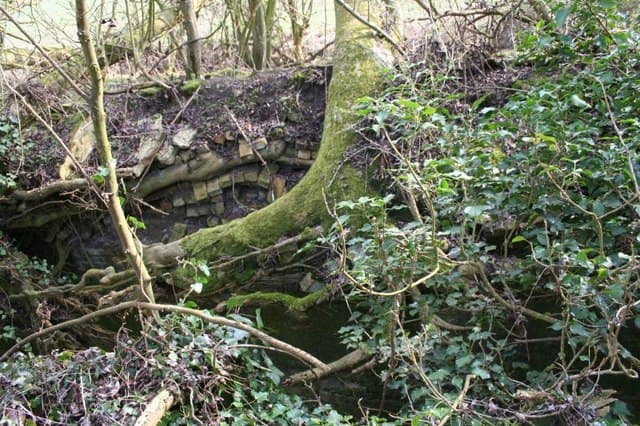
USDA Natural Resources Conservation Service / Wikimedia Commons / Public Domain
ROOT DAMAGE FROM CONSTRUCTION OR GRADE CHANGE
What It Looks Like
- Tree within 50 ft of recent construction, trenching, or paving
- Soil grade has been raised or lowered around the base
- Gradual crown thinning and dieback 2–5 years after construction
Soil compaction, trench cuts through root zone, or grade changes suffocate and sever feeder roots; trees show delayed decline 3–7 years after damage because stored energy masks the injury
What Happens If Ignored
Root loss is permanent. The tree will continue declining and become structurally compromised once its energy reserves are depleted — often 5–10 years after the damage event.
Recommended Action
Aeration, mulching, and reduced competition can slow decline if addressed early. Have an arborist assess root zone condition. Document the grade change or construction date — it matters for diagnosis.
WHEN IN DOUBT, A FREE ASSESSMENT COSTS NOTHING.
A FALLEN TREE COSTS EVERYTHING.
Not sure what you're looking at? Our certified arborists serve Marietta, Kennesaw, Smyrna, Acworth, and greater Cobb County. We'll tell you exactly what's going on and what needs to happen next — no pressure, no upsell.