Tree Care
How to Prepare Your Yard for Tree Removal in Marietta
A Marietta homeowner's checklist for clearing access, protecting belongings, coordinating the work area, and staying safe on tree-removal day.
Read article →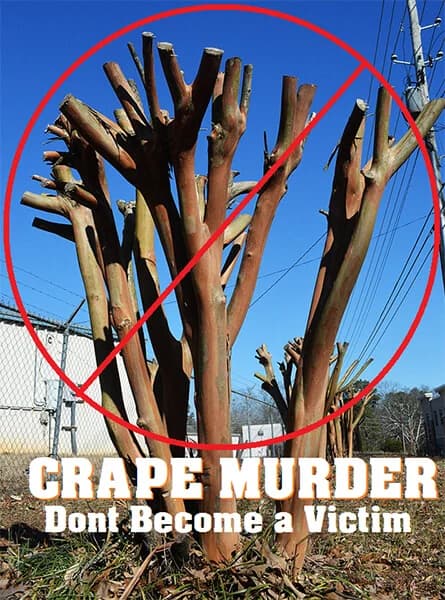
Crown reduction pruning and topping are sometimes described in the same breath — both involve removing upper branches to reduce a tre’ height. The similarity ends there. Crown reduction is an ISA-recognized technique that reduces height by cutting back to a lateral branch at least one-third the diameter of the removed stem. The cut is made just outside the branch collar, and the lateral continues to grow as the new leader.
Topping is cutting main branches back to stubs, typically in the middle of a limb with no lateral target. The cut has no collar tissue to work with, and the tree has no biological mechanism to close the wound. Decay enters immediately. Within two to five years, the topped tree produces dense watersprout regrowth — weakly attached shoots that fail in the next storm.
The visual difference is unmistakable once you know what to look for: a properly reduced tree has rounded cut surfaces where branches were removed to laterals. A topped tree has flat, blunt stubs — sometimes called "hatracks" — with clusters of fast-growing vertical shoots emerging from each one.
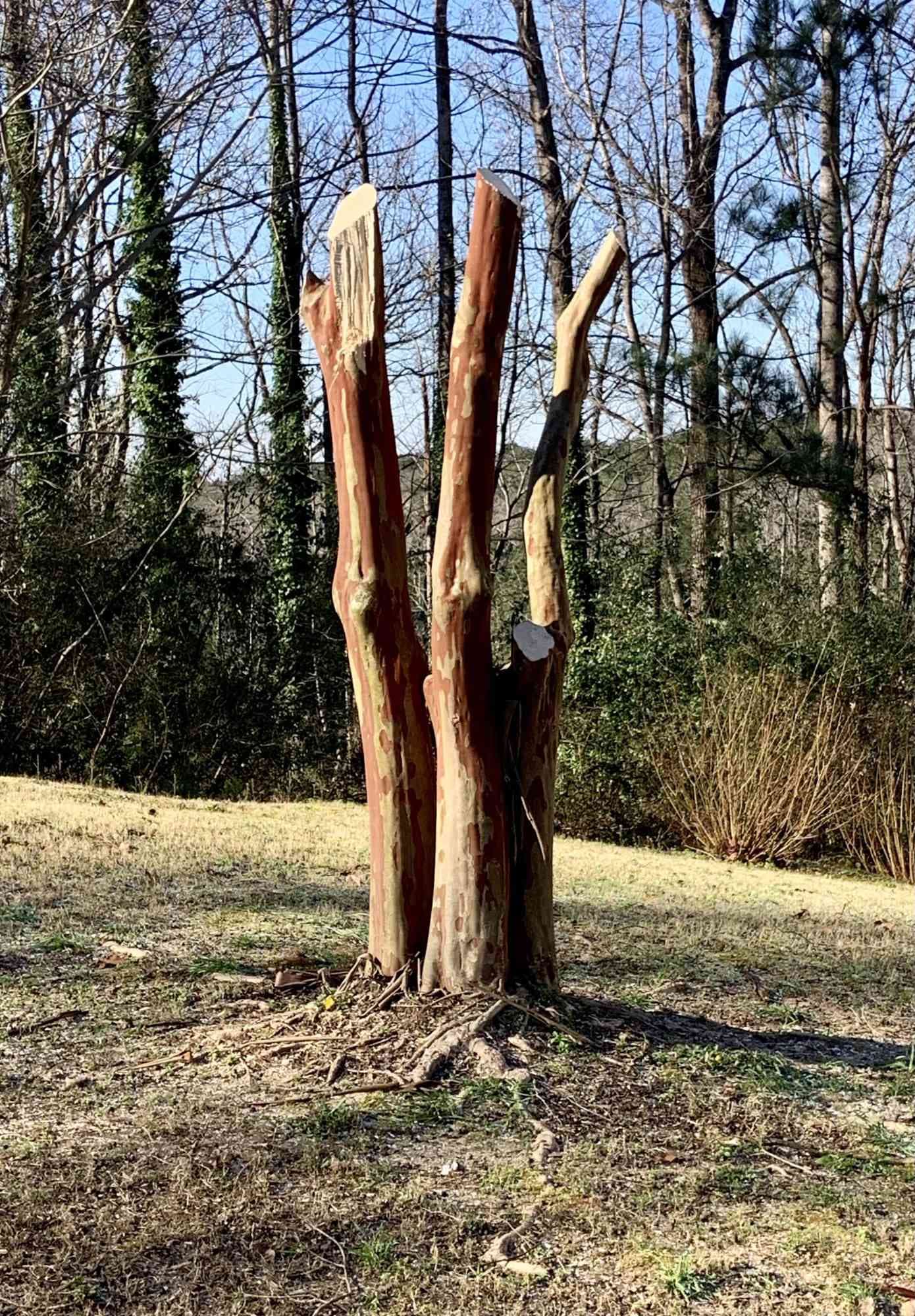
No tree in Georgia gets pruned more aggressively — or more incorrectly — than the crape myrtle. The practice of cutting all major branches back to thick knuckles is so widespread in the Southeast that it has a name: crape murder. The result is a tree that survives and blooms, but with a structurally compromised form that weakens over time.
Crape myrtles respond to hard cuts by producing many shoots from the dormant buds near each cut. These watersprouts grow fast, reach flowering size quickly, and bloom — which is why the technique is persistent. What the blooms mask is the structural damage: each cut creates a large wound that cannot close properly, and the dense sprout clusters add considerable wind load to the now-reduced branch structure.
Proper crape myrtle pruning is selective. Remove whole branches at the collar rather than cutting into the middle of a limb. Target crossing branches, inward-facing growth, and basal sprouting. The goal is a vase-shaped canopy with well-spaced scaffold branches — not a cluster of knobbed stubs at the top of bare trunks.
Crape myrtles benefit from pruning in late winter while dormant — February in Georgia — before new growth begins. This timing produces the strongest flowering response on the upcoming season’s growth.
Removing a large limb — anything over three to four inches in diameter — requires more than one cut. The goal is to prevent the weight of the branch from tearing bark down the trunk as it falls. The three-cut technique manages that weight sequence.
The first cut is an undercut, placed 12 to 18 inches from the trunk, cutting upward from the bottom of the branch to about one-third of the branc’ diameter. This cut prevents the bark from splitting downward when the branch eventually separates.
The second cut is a top cut, placed a few inches further from the trunk than the undercut. Cut downward from the top until the branch falls, supported by the uncut stub portion. The undercut and this relief cut together remove most of the weight without risk of bark tearing.
The third cut is the final cut, made just outside the branch collar — the slightly swollen ring of tissue where the branch meets the trunk. This cut preserves the collar, which contains the tre’ wound-closure chemistry. The resulting wound will eventually be covered by callus tissue growing in from the collar.
Crown cleaning is the most common routine pruning operation for mature trees. It involves removing dead, diseased, and weakly-attached branches from throughout the canopy. Unlike crown reduction (which changes the tre’ size) or crown thinning (which reduces density), crown cleaning is purely corrective: taking out what is already failing.
Deadwood removal is the highest priority in crown cleaning. Dead branches have no mechanical strength and can fall without warning in calm conditions, let alone during a storm. They also provide entry points for decay fungi that can advance into the main stem. Removing deadwood from the crown eliminates both the falling hazard and the decay inoculation risk.
Crossing branches — two limbs that rub against each other over time — create wound sites where bark is worn away by friction. The resulting open wood invites fungal colonization. One of the two crossing branches should be removed at the collar during crown cleaning.
A properly cleaned canopy has a naturally open appearance. Light and air move through the crown freely. Scaffold branches are well-spaced without crowding. The tre’ natural form is preserved — the goal is health and safety, not aesthetic shaping.
Live oak and water oak are the dominant large-canopy species in Marietta and across Cobb County. Both species present specific pruning considerations that Georgia homeowners should understand before hiring any operator.
First, timing matters for oaks specifically. Oak wilt, a fungal disease transmitted by sap-feeding beetles, is active in the Southeast from April through July. Any pruning cuts made during this window attract the beetles that spread the fungus. ISA and UGA Extension both recommend avoiding pruning oaks during this period unless there is a safety emergency.
Second, live oaks develop very strong branch collars, and their bark is deeply furrowed. The collar is often not obvious until you look closely. Look for the slightly raised ring of darker, more compressed bark at the branch attachment. The cut goes just outside that ring.
Third, live oaks are frequently host to epiphytes — Spanish moss, ball moss, and resurrection fern — that are generally harmless to the tree but sometimes mistaken for disease by homeowners. An arborist can distinguish between epiphytes and actual foliar disease during a routine assessment.
A certified arborist working on a mature live oak should be using climbing spikes only when the tree is being removed — not during routine pruning. Spike climbing on a living oak creates wounds that remain for the life of the tree and can initiate internal decay columns.
Keep reading
A Marietta homeowner's checklist for clearing access, protecting belongings, coordinating the work area, and staying safe on tree-removal day.
Read article →A practical guide for Atlanta-area homeowners comparing tree-service estimates, safety plans, cleanup, stump work, and emergency availability.
Read article →Tree removal and tree trimming solve different problems. This homeowner guide explains how to choose the safer service for a Georgia property before a small concern becomes storm damage.
Read article →FREE ON-SITE ASSESSMENTS ACROSS COBB COUNTY.
Serving Marietta, Kennesaw, Smyrna, Acworth, and greater Cobb County. Our certified arborists will tell you exactly what's going on — no pressure, no upsell.