Tree Care
How to Prepare Your Yard for Tree Removal in Marietta
A Marietta homeowner's checklist for clearing access, protecting belongings, coordinating the work area, and staying safe on tree-removal day.
Read article →In common usage, "trimming" and "pruning" both mean cutting branches off a tree. In arborist practice, they describe different operations with different goals.
"Trimming" usually refers to aesthetic shaping — cutting back branches to manage the size, shape, or appearance of a tree or shrub. The goal is visual: keeping a hedge tight, clearing a branch that overhangs the driveway, or reducing a tree’s visual mass. Trimming decisions are primarily made for the convenience of the property owner, not the health of the plant.
"Pruning" — in the ISA and ANSI A300 sense — is a structural and biological intervention. The goal is to remove specific branches for the long-term health, safety, or structural integrity of the tree. Pruning decisions are driven by what's happening inside the tree: removing deadwood, improving light penetration, reducing failure risk at a weak attachment, or shaping a young tree's scaffold for long-term form. Done correctly, pruning extends a tree's life. Done incorrectly — or when trimming crosses into structural territory without the knowledge to support it — it can shorten it.
ANSI A300 is the professional standard for tree care in the United States, published by the American National Standards Institute and developed with ISA input. It defines four pruning objectives that every legitimate arborist should be familiar with.
**Crown Cleaning** removes dead, dying, diseased, and weakly-attached branches from the crown. It's the most common routine pruning type — maintaining a tree's health by removing the wood most likely to fail or introduce decay into the system.
**Crown Thinning** selectively removes branches to increase light penetration and air movement through the crown without changing its overall size or shape. Thinning reduces sail area (the surface the wind pushes against) and is often used to reduce wind-throw risk on large trees near structures.
**Crown Raising** removes the lower branches of a tree to provide clearance beneath the crown — for vehicles, pedestrians, sight lines, or structures. The key is doing it gradually over several years; removing too many lower branches at once stresses the tree.
**Crown Reduction** reduces the height and spread of a tree by cutting back to laterals — secondary branches capable of sustaining the remaining crown. Done correctly, it's a legitimate alternative to topping for managing tree size. Done incorrectly, it becomes topping.
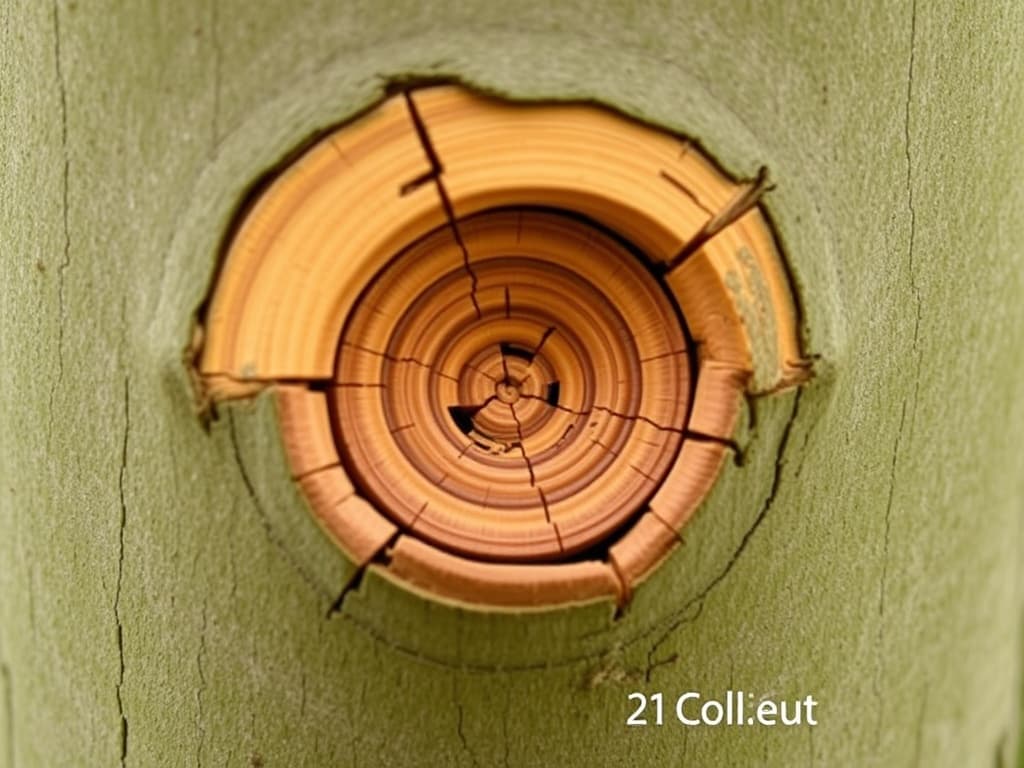
A proper collar cut produces this wound closure pattern — callus tissue growing inward from the collar.
Generated by Polsia / Affordable Tree Experts
Every branch meets the trunk or parent stem at a point called the branch collar — a slightly swollen, ridged zone of specialized tissue. This collar is the tree's primary defense against decay entering through a pruning wound. It contains chemical compounds and structural features that, when a cut is made just outside it, trigger wound closure and compartmentalization of any decay that begins.
The correct pruning cut is made just outside the branch collar — preserving the collar tissue intact while removing the branch. This leaves a small, rounded stub that the tree can close over in one to three growing seasons, depending on the species and the cut diameter.
The wrong cut — flush with the trunk — removes the collar entirely, eliminating the tree's ability to compartmentalize the wound. Decay enters immediately and spreads into the trunk. This single mistake, repeated across multiple pruning cuts, can shorten a tree's life by decades.
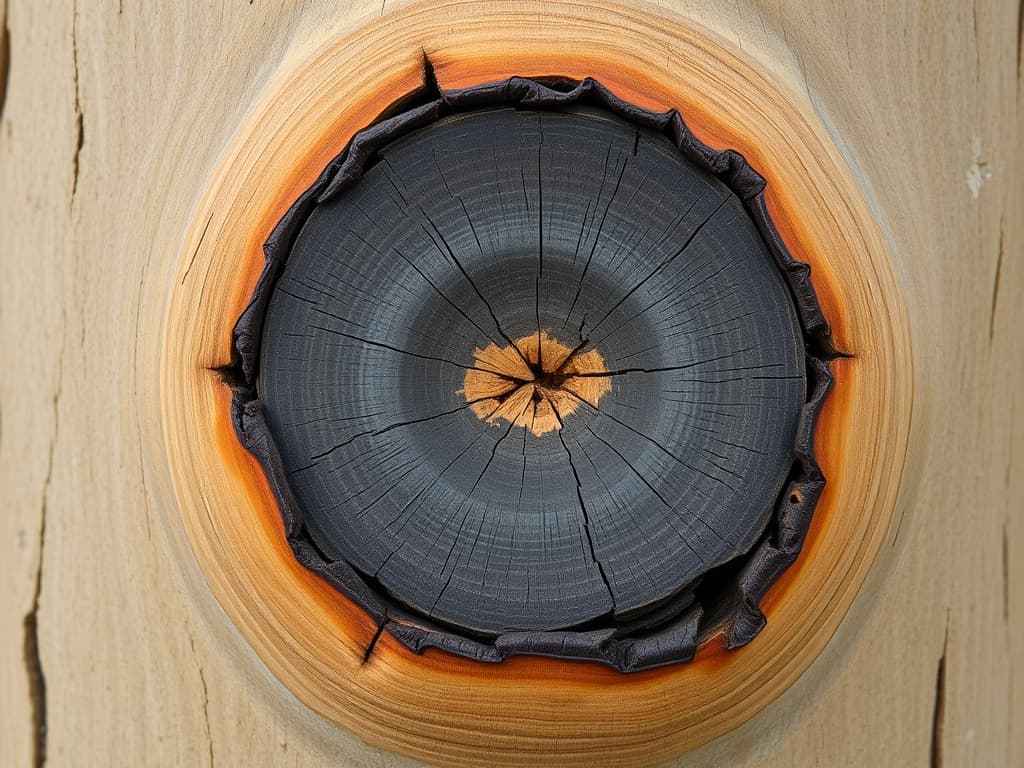
A flush cut stays flat and sunken — no collar tissue means no wound closure.
Generated by Polsia / Affordable Tree Experts
Before hiring any tree company, look at their previous work if you can. The telltale sign of flush cutting is a flat, recessed scar on the trunk where a branch used to be — no rounded callus growth at the edges, no collar-shaped wound closure pattern.
A properly healed pruning wound shows concentric rings of callus tissue growing inward from the edges, eventually closing over the cut surface. A flush cut scar stays flat, often with a sunken center where wood has died or decayed, and bark curling away at the edges.
On a tree that's been worked on recently, look at the stubs. A proper cut will show the branch collar raised slightly around the cut face — a doughnut of bark and wood tissue. A flush cut will be smooth and flat, continuous with the trunk surface. If a company's recent work shows flush cuts across multiple trees, move on.
For most Georgia hardwoods — oak, hickory, sweetgum, tulip poplar, dogwood — dormant-season pruning (late November through February) is the preferred window. Trees are leafless, making structure easier to see and assess. Wounds close faster in the following spring's growth flush. And many decay fungi are less active in cold weather, reducing the chance of immediate colonization of fresh pruning wounds.
The major exception is oak. In the Southeast, oak wilt (Ceratocystis fagacearum) is a disease transmitted by sap-feeding beetles that are most active when oaks are wounded during the growing season. ISA and UGA Extension both advise avoiding pruning cuts on oaks from April through July — the peak beetle flight period — unless there's a safety emergency requiring immediate action. When emergency cuts are necessary during that window, wound dressings (specifically approved ISA products, not paint) can reduce beetle attraction to fresh cuts.
For pines, which are among the most common residential trees in Cobb County, the dormant season is also generally preferred, though pines can typically be pruned year-round if needed. Avoid pruning pines in August and September when pine bark beetle populations peak in Georgia.
The line between "trimming" and topping is often crossed by operators who don’t know — or don’t care — about ISA standards. Before any significant work on a mature tree, ask three questions.
First: "Where will you make the cuts?" The answer should describe cutting back to specific laterals, removing specific problem branches, or cleaning the crown. If the answer is "we’ll just take off the top" or "we’ll cut it down to about this height," walk away.
Second: "Do you have ISA Certified Arborist credentials?" Tree work doesn’t require a license in Georgia, which means anyone can call themselves a tree company. ISA certification requires passing a written exam on tree biology, pruning standards, and hazard assessment. Ask for the credential number and verify it at treesaregood.org.
Third: "Can you show me a certificate of insurance?" Liability insurance and workers’ compensation coverage protect you if something goes wrong on your property. A company that hesitates or can’t provide current certificates is not a company worth hiring.
Keep reading
A Marietta homeowner's checklist for clearing access, protecting belongings, coordinating the work area, and staying safe on tree-removal day.
Read article →A practical guide for Atlanta-area homeowners comparing tree-service estimates, safety plans, cleanup, stump work, and emergency availability.
Read article →Tree removal and tree trimming solve different problems. This homeowner guide explains how to choose the safer service for a Georgia property before a small concern becomes storm damage.
Read article →FREE ON-SITE ASSESSMENTS ACROSS COBB COUNTY.
Serving Marietta, Kennesaw, Smyrna, Acworth, and greater Cobb County. Our certified arborists will tell you exactly what's going on — no pressure, no upsell.