Tree Care
How to Prepare Your Yard for Tree Removal in Marietta
A Marietta homeowner's checklist for clearing access, protecting belongings, coordinating the work area, and staying safe on tree-removal day.
Read article →Topping is the practice of cutting a tree's main branches back to stubs — usually removing anywhere from 25% to 75% of the crown in a single cut. The result is a tree reduced to a skeleton of large, blunt-ended stubs where branches used to be.
Homeowners usually ask for it with good intentions: the tree feels too tall, too close to the house, or too likely to fail in a storm. "Just take the top off" seems like a reasonable middle ground between doing nothing and removing the tree entirely.
The problem is that topping doesn't do what people expect it to do. It doesn't reduce risk — it creates risk. And it sets off a chain of biological events that, in most species, leads to a more dangerous and less healthy tree within two to five years.
The International Society of Arboriculture is unambiguous on this: topping is not an accepted arboricultural practice. ISA's position statement, echoed in TCIA best practices and ANSI A300 pruning standards, holds that topping causes predictable, serious harm to trees and should not be performed by a qualified arborist.
The ANSI A300 standard — the professional benchmark for tree pruning in the United States — does not include topping as a pruning objective. Any arborist who performs topping is operating outside the standards of the profession.
This isn't a fringe position. It's the consensus of every major professional arboricultural organization in the country, backed by decades of research into how trees respond to large-wound pruning.
A healthy tree seals pruning wounds by growing callus tissue — a roll of bark and wood that gradually closes over a cut. This process works well for cuts made at the right location: just outside the branch collar, the swollen zone of protective tissue at the base of every branch.
Topping cuts are made in the middle of a branch — far from any branch collar. There is no collar tissue, no protective zone, no biological machinery for the tree to deploy. The stub is left with a large, flat cut surface that cannot properly seal. Decay-causing fungi enter immediately through that exposed wood and begin moving down into the main stem.
ISA research documents that topped stubs often die back entirely within two to three years as decay advances. By then, the trunk itself is compromised — hollowed from the inside, while the exterior may still look intact.
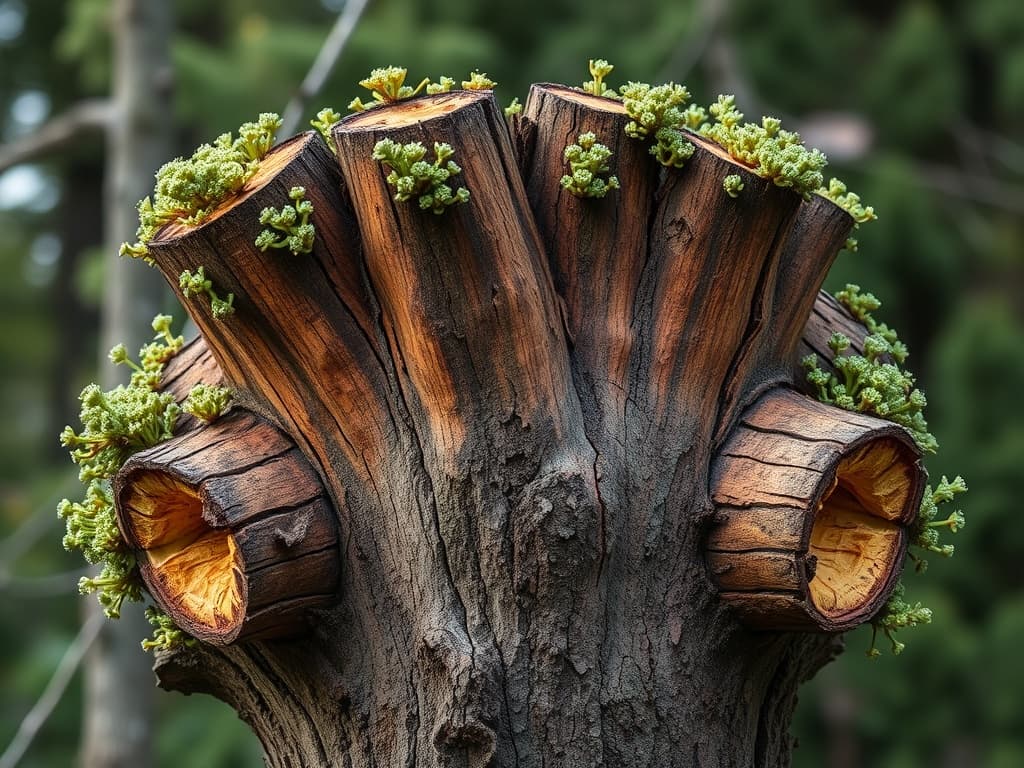
Topped trees regenerate dense, weakly-attached watersprouts from each stub — more growth, more hazard.
Generated by Polsia / Affordable Tree Experts
Topping triggers a survival response. The tree, having lost most of its food-producing leaf area, pushes out dense clusters of fast-growing shoots called watersprouts from dormant buds near each stub. Within a single growing season, a topped tree can produce 10 to 20 feet of new growth.
Here's the problem: that new growth is weakly attached. Watersprouts develop from surface tissue rather than the deep wood matrix that anchors a normal branch. They lack the mechanical connection of a branch that grew naturally over years. In a storm, they snap off at the point of attachment — exactly the failure mode homeowners were trying to prevent.
Within five years, a topped tree is often taller than it was before topping, covered in dense, weakly-attached watersprouts, and internally decayed from the stub wounds. The homeowner has paid for topping, watched the tree grow back rapidly, and now has a more dangerous tree than they started with.
Wood decay in trees is not static. Fungi that enter through a topping cut colonize the exposed wood and advance downward through the main stem. The larger the cut surface, the more entry points for decay, and the faster the process moves.
A tree that was structurally sound before topping can develop significant internal decay within three to five years. From the outside, the tree may still look like it's leafing out and growing. Inside, the wood that supports the crown may be soft, punky, or hollow.
This internal decay is what makes topped trees so dangerous. They fail suddenly, without the visible warning signs — crown dieback, bark loss, fungal fruiting — that allow arborists to identify hazardous trees. The tree looks green, the homeowner assumes it's fine, and then a storm brings down a 30-foot section of decayed trunk.
There is a legitimate alternative to topping for reducing a tree's height or spread: crown reduction pruning, performed according to ANSI A300 standards. Unlike topping, crown reduction makes cuts back to a lateral branch — a secondary stem that is at least one-third the diameter of the stem being removed.
This technique is called "reduction to a lateral" in ISA terminology. The lateral continues to grow and eventually replaces the removed stem, maintaining a living, growing end-point instead of a dead stub. The tree’s form and food-production capacity are maintained. Wound closure occurs because cuts are made at proper locations with collar tissue present.
Crown reduction reduces the tree's height and spread by typically 15–25% without triggering the decay-and-watersprout cycle that topping causes. It requires more skill, more time, and more careful planning than topping — which is why less qualified operators don't offer it.
Before you hire anyone to work on a mature tree, ask them one question: "Do you top trees?" A qualified, ISA-certified arborist will tell you they do not — and will explain why. An operator who says yes, or who proposes topping as a solution to your concern, is not operating within professional standards.
ISA certification requires demonstrating knowledge of pruning standards, tree biology, and hazard assessment. Certified arborists are bound by a code of ethics that includes avoiding practices known to cause harm. Topping violates that standard.
Look for the ISA Certified Arborist credential (searchable at treesaregood.org), and ask for proof of liability insurance and workers' compensation coverage before any work begins on your property. A real professional will provide both without hesitation.
Keep reading
A Marietta homeowner's checklist for clearing access, protecting belongings, coordinating the work area, and staying safe on tree-removal day.
Read article →A practical guide for Atlanta-area homeowners comparing tree-service estimates, safety plans, cleanup, stump work, and emergency availability.
Read article →Tree removal and tree trimming solve different problems. This homeowner guide explains how to choose the safer service for a Georgia property before a small concern becomes storm damage.
Read article →FREE ON-SITE ASSESSMENTS ACROSS COBB COUNTY.
Serving Marietta, Kennesaw, Smyrna, Acworth, and greater Cobb County. Our certified arborists will tell you exactly what's going on — no pressure, no upsell.